
 Electronics Design & Development
 PCB Design & Layout Services
 PCB Fabrication & Prototyping
 PCB Assembly & PCBA Services





Industrial IoT Rigid Flex PCB Manufacturer: Solving the Challenges of Harsh Environment Applications
Industrial IoT Rigid Flex PCB Manufacturer: Solving the Challenges of Harsh Environment Applications
Industrial IoT (IIoT) devices operate in some of the harshest environments on earth, from extreme temperatures and humidity to heavy vibration and chemical exposure. These conditions pose unique challenges for PCB design and manufacturing. As a specialized IoT device rigid flex PCB manufacturer, we have the expertise and capabilities to design and produce rigid flex PCBs that can withstand these harsh conditions while delivering reliable performance.
Unique Challenges of Industrial IoT PCB Design
1. Temperature Extremes
Industrial IoT devices often operate in environments where temperatures can range from -40°C to 125°C or higher. Traditional rigid PCBs can fail under these conditions due to thermal expansion and contraction, which can cause solder joints to crack and traces to break.
2. Vibration and Shock
Industrial equipment like pumps, motors, and conveyor belts generate significant vibration and shock. Traditional rigid PCBs with their fixed components and wiring are susceptible to damage from these forces, leading to premature failure.
3. Moisture and Chemical Exposure
Many industrial environments are humid or expose devices to chemicals like oil, grease, and solvents. These substances can corrode PCB traces and components, leading to electrical failures.
4. High Reliability Requirements
Industrial IoT devices are often critical to the operation of manufacturing plants, power grids, and transportation systems. They must operate reliably for years without maintenance, with mean time between failures (MTBF) measured in hundreds of thousands of hours.
Our Industrial IoT Rigid Flex PCB Manufacturer Solutions
1. Ruggedized Design and Materials
As a leading IoT device rigid flex PCB manufacturer, we use ruggedized design techniques and materials to ensure that our industrial IoT PCBs can withstand harsh environments:
High-Temperature Materials: We use materials like Rogers RO3003 and DuPont Pyralux that can withstand temperatures up to 200°C without degradation.
Reinforced Flexible Sections: We add stiffeners to flexible sections to provide additional support and reduce stress on components.
Conformal Coating: Applying a protective conformal coating to the PCB to prevent moisture and chemical damage.
Shielding: Using metal shielding cans and grounded traces to protect sensitive components from electromagnetic interference (EMI) in industrial environments.
2. Advanced Manufacturing Processes
Our manufacturing processes are optimized for industrial IoT rigid flex PCBs:
High-Density Interconnect (HDI) Technology: For creating small, compact PCBs with high component density.
Controlled Impedance Routing: For ensuring reliable transmission of high-speed signals in noisy industrial environments.
Thermal Management: Using heat sinks, thermal vias, and copper planes to dissipate heat from high-power components.
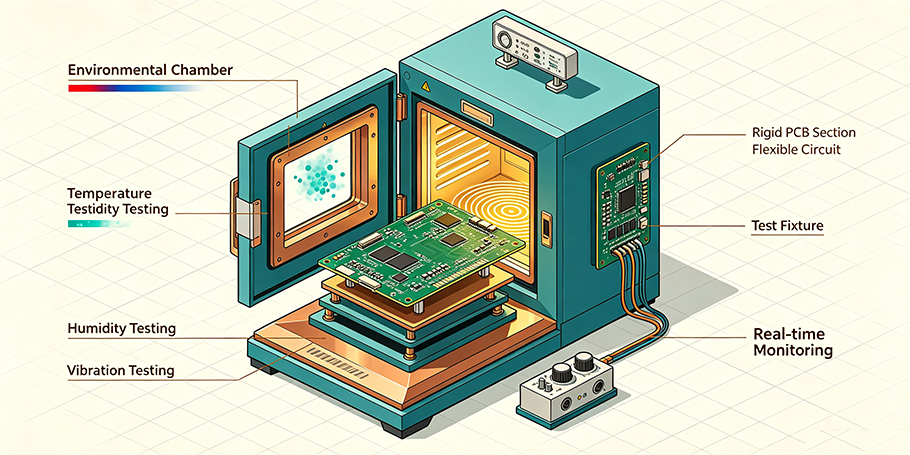
Reliability Testing: Performing rigorous testing, including temperature cycling, vibration testing, and salt spray testing, to ensure that each PCB meets our high reliability standards.
3. Compliance with Industrial Standards
Our industrial IoT rigid flex PCBs comply with strict industry standards, including:
IPC-A-600: Acceptability of printed boards.
IPC-A-620: Acceptability of electronic assemblies.
UL 796: Standard for printed wiring boards.
ISO 16750: Environmental conditions and testing for electrical and electronic equipment in road vehicles.
Case Study: Oil and Gas Sensor Rigid Flex PCB Design
The Challenge
An oil and gas company needed a IoT device rigid flex PCB manufacturer to design a PCB for a downhole pressure sensor. The PCB needed to withstand temperatures up to 150°C, pressures up to 10,000 psi, and heavy vibration from drilling operations.
Our Solution
We designed a 4-layer rigid flex PCB with:
A rigid section for mounting the sensor and communication module.
A flexible section that could bend to fit into the sensor's housing.
High-temperature materials (Rogers RO3003 and DuPont Pyralux) that could withstand 150°C.
A conformal coating to protect against moisture and chemical exposure.
Reinforced stiffeners to reduce stress on the flexible section during installation.
The Results
The final PCB passed all reliability tests, including temperature cycling from -40°C to 150°C, vibration testing at 20g, and pressure testing at 10,000 psi. The sensor has been deployed in over 1,000 wells worldwide, with an MTBF of over 500,000 hours. The client reported a 99% first-pass yield, reducing production costs and minimizing downtime in the field.
Conclusion
Industrial IoT devices face unique challenges that require specialized PCB design and manufacturing expertise. As a leading IoT device rigid flex PCB manufacturer, we have the experience and capabilities to design and produce rigid flex PCBs that can withstand the harshest environments while delivering reliable performance.
Whether you're developing oil and gas sensors, industrial robots, or smart grid equipment, we can help you create a rugged, reliable PCB that meets your specific needs. Contact us today to schedule a free consultation and learn how our IoT device rigid flex PCB manufacturer services can help you solve the challenges of industrial IoT applications.
