
 Electronics Design & Development
 PCB Design & Layout Services
 PCB Fabrication & Prototyping
 PCB Assembly & PCBA Services





Weidmuller 2026 PCB Design Survey: AI Tool Adoption, Reliability Priorities & Engineer Insights
Weidmuller USA Releases 2026 National PCB Design Survey: Engineers Share Insights on Tools, AI & Component Priorities
Weidmuller USA, a leader in smart industrial connectivity and automation solutions, today released key findings from its 2026 National PCB Design Survey, conducted in partnership with EETech Research. The survey of 400 North American engineers reveals critical insights into PCB component selection trends, AI tool adoption in PCB design, and the industry's unwavering focus on reliability over cost.
The study underscores that while AI tools for PCB design are becoming normalized in engineering workflows, significant gaps remain between current capabilities and what engineers need to maximize efficiency and accuracy. Additionally, reliability continues to dominate decision-making, with nearly 8 in 10 engineers prioritizing durability over price when selecting components.
Survey Key Findings: Reliability Reigns Supreme in PCB Design
Reliability emerged as the most critical factor in every stage of PCB design and component selection, reflecting the industrial sector's demand for long-lasting, high-performance electronic systems:
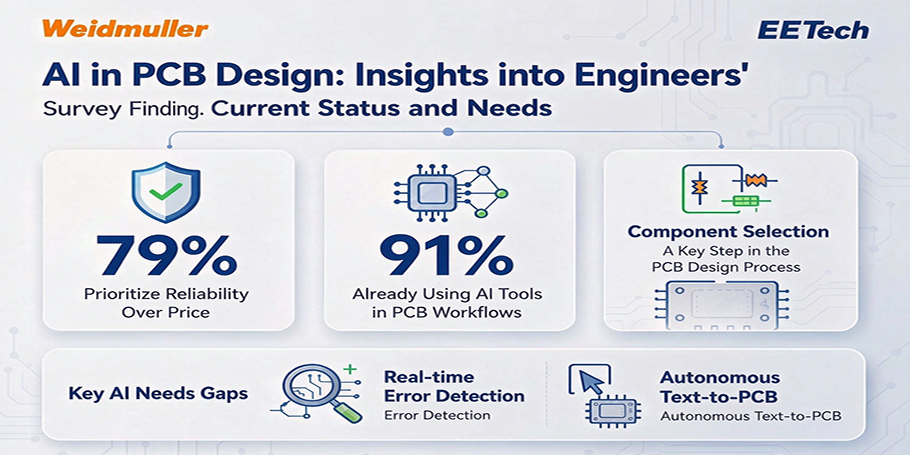
79% of engineers identified "high reliability and durability" as the most important feature for device connectivity, compared to just 22% who cited price as their top priority.
Top reasons for switching to a new product or component in the past 2-3 years were better performance (58%), cost savings (32%), and improved reliability (29%).
Component selection timing varies: 43% finalize choices in the early concept/architecture phase, 26% use an iterative approach across multiple stages, and 31% wait until the layout phase.
"This new research reinforces the importance that engineers place on improvement in performance, reliability, workflow efficiency and supply resilience, especially when these benefits are integrated directly into the PCB design process," said John Froustet, Senior Director, Product Portfolio Management at Weidmuller USA. "While AI tools are increasingly looked to for speed and accuracy, many questions around data security and accuracy of results still linger."
AI Tool Adoption in PCB Design: Widespread Use, but Critical Gaps Remain
The survey highlights rapid adoption of AI in PCB design workflows, with 91% of engineers reporting they use AI-based tools in their daily work. Currently, the primary value of AI is seen as faster design iterations (65%), enabling engineers to test more concepts in less time.
However, write-in responses revealed significant gaps between the promise of AI and its current capabilities. Engineers identified key unmet needs in AI tools for PCB design:
Real-time error detection (48%): Automatically identifying design flaws during layout to reduce rework.
Fully autonomous text-to-PCB conversion (37%): Translating natural language design requirements directly into functional PCB layouts without manual intervention.
Improved data security (29%): Ensuring proprietary design data remains protected when using cloud-based AI tools.
Context-aware design recommendations (25%): AI that understands industry-specific requirements (e.g., industrial, automotive) to provide targeted design suggestions.
Implications for PCB Designers & Component Manufacturers
The survey results offer actionable insights for both engineering teams and component suppliers:
For engineers: Prioritize reliability in component selection early in the design process to avoid costly rework, and evaluate AI tools based on their ability to address specific workflow gaps like real-time error detection.
For manufacturers: Invest in AI tool development that focuses on unmet needs like autonomous design capabilities, and emphasize reliability and performance in product messaging to align with engineer priorities.
For the industry: Continue advancing AI technology to bridge capability gaps, while addressing concerns around data security and accuracy to build trust in AI-driven design workflows.
Survey Methodology & Background
The 2026 National PCB Design Survey was conducted by EETech Research between April and May 2026, polling 400 North American engineers across industrial, automotive, and consumer electronics sectors. Respondents completed an anonymous 28-question survey covering component selection criteria, AI tool usage, and design workflow challenges.
Weidmuller USA, a pioneer in smart industrial connectivity for over 50 years, commissioned the survey to better understand evolving engineer needs and inform future product development. The full survey report is available for download on the Weidmuller USA website.
About Weidmuller USA
Weidmuller USA, headquartered in Richmond, Va., is a leading provider of smart industrial connectivity and automation products and solutions. As part of the global Weidmüller Group, the company serves customers in over 80 countries, delivering innovative, sustainable technology tailored to industrial transformation needs. Learn more at weidmuller.com.
About EETech
EETech is a community-driven technology company connecting engineers and technical professionals with industry insights, resources, and research. With a global community of millions of engineers and decades of research experience, EETech delivers data-driven insights to help businesses make strategic decisions. Learn more at eetech.com.
