
 Electronics Design & Development
 PCB Design & Layout Services
 PCB Fabrication & Prototyping
 PCB Assembly & PCBA Services





Choosing the Right Materials for Commercial PCBs: Thermal, Signal, and Durability Factors
The substrate you choose for your PCB is not just a mechanical carrier—it’s an active participant in electrical performance and longevity. In commercial applications, where products run 24/7 in varying environments (from office servers to outdoor kiosks), material misjudgment is the leading cause of premature failure. This guide navigates the maze of laminates, prepregs, and surface finishes, focusing on how to match material properties to your product’s operational profile. Whether you’re designing a power supply or a 5G gateway, understanding the trade-offs in PCB design and manufacturing for commercial applications will empower you to specify the right materials from the start.
1. FR-4: The Workhorse – But Which Grade?
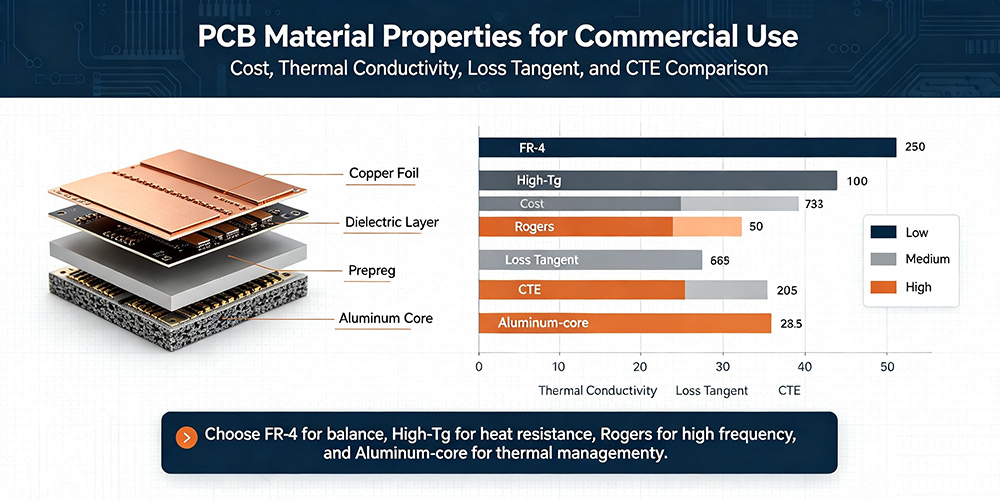
Standard FR-4 (Tg ~130°C) is adequate for many consumer electronics with benign environments. However, for commercial products exposed to ambient temperatures above 70°C (e.g., telecom cabinets or automotive interiors), standard FR-4 softens, leading to Z-axis expansion that cracks plated through-holes. Upgrade to FR-4 High-Tg (Tg ≥170°C) or FR-5, which retains mechanical strength at higher temperatures. Additionally, consider the decomposition temperature (Td) – a high Td (>340°C) ensures the material withstands lead-free soldering without delamination. For cost-sensitive commercial designs, a medium-Tg (150°C) material like Isola 370HR offers a sweet spot – it’s moderately priced yet robust enough for most industrial control applications.
2. High-Speed Digital and Low-Loss Laminates
As commercial devices embrace high-speed interfaces (USB 3.2, PCIe Gen4, 10GbE), signal integrity becomes a material-driven issue. Loss tangent (Df) and dielectric constant (Dk) determine insertion loss and impedance variation. Traditional FR-4 has a Df of 0.02–0.025, causing significant attenuation above 5 GHz. For 5G small cells or high-end routers, choose low-loss materials like Rogers 4350B (Df 0.0037) or Panasonic Megtron 6 (Df 0.005). However, these are expensive. A pragmatic approach: use a “hybrid” stack-up – low-loss material only on outer layers for critical high-speed traces, and standard FR-4 for inner power/ground planes. Ensure the prepreg between layers has a controlled Dk to maintain impedance; work with your laminator to validate the hybrid bonding process.
3. Thermal Conductivity and Heat Dissipation
Commercial power electronics – motor drives, LED arrays, and battery management systems – generate substantial heat. Standard FR-4 has poor thermal conductivity (~0.3 W/m·K), requiring bulky heatsinks. Consider metal-core PCBs (MCPCBs) with aluminum or copper base layers, offering 1–3 W/m·K, which direct heat away from components. For less extreme cases, use thermally conductive prepregs or add thermal vias (filled with copper) to conduct heat to internal planes. Also, evaluate the CTE (Coefficient of Thermal Expansion) mismatch between the substrate and component leads – a mismatched CTE causes solder joint fatigue. High-Tg materials have lower CTE (≤50 ppm/°C), closer to ceramic components, which extends thermal cycle life. For commercial applications with temperature fluctuations of 40°C daily, choose materials with CTE <70 ppm.
4. Moisture Absorption and CAF Resistance
Commercial environments often involve humidity and condensation. Moisture absorbed into the PCB can reduce insulation resistance and promote Conductive Anodic Filament (CAF) – a failure where copper ions migrate between adjacent conductors under bias. Choose materials with low moisture absorption (<0.5% per IPC-4101). Moreover, specify CAF-resistant resins such as halogen-free or phenolic-cured systems. For high-voltage commercial applications (e.g., HVAC controllers), increase the spacing between holes and ensure the laminate has a high glass transition and low ionic contamination. Request the fabricator to perform CAF testing on qualification coupons; this extra step is invaluable for products with a 10-year expected life.
5. Surface Finish: Beyond Cost – Performance and Shelf Life
The surface finish protects copper pads and ensures solderability. For commercial manufacturing, ENIG remains the gold standard for fine-pitch and aluminium wire bonding, but it’s costly and subject to “black pad” issues. Immersion silver is a cost-effective alternative with good planarity and lower cost, but it tarnishes if exposed to sulfur; use it only if your product is sealed. ENEPIG (Electroless Nickel Electroless Palladium Immersion Gold) is gaining traction for mixed assemblies (SMT + wire bonding) and offers excellent durability. For low-cost consumer goods, HASL (Hot Air Solder Leveling) is still used, but its uneven surface thickness is problematic for BGAs. The recommendation for commercial applications with moderate complexity: Immersion Silver or ENIG, depending on shelf-life requirements. Also, specify a maximum shelf life (e.g., 6 months) and control storage conditions (temperature/humidity) to preserve wettability.
6. Flame Retardancy and Regulatory Compliance
Most commercial electronics require UL 94 V-0 rating for fire safety. Ensure your chosen laminate meets this, and request a UL recognition file from the supplier. Additionally, many commercial products selling in Europe must comply with RoHS (Restriction of Hazardous Substances) – choose halogen-free materials to simplify compliance. While halogen-free resins are slightly more expensive, they offer better electrical properties and lower smoke emission, which is an added safety factor. Always obtain material data sheets that include all mechanical, thermal, and electrical parameters, and cross-check them against your design’s worst-case conditions.
Conclusion
Material selection is not a one-size-fits-all decision in PCB design and manufacturing for commercial applications. By systematically evaluating Tg, Dk/Df, thermal conductivity, moisture resistance, and finish cost, you can tailor the material set to your product’s environmental and electrical demands. Collaborate with your fabricator to validate the stack-up and run test coupons before volume production. A well-chosen material stack ensures your commercial PCB delivers consistent performance over its entire lifecycle, protecting your brand and reducing warranty expenses.
