
 Electronics Design & Development
 PCB Design & Layout Services
 PCB Fabrication & Prototyping
 PCB Assembly & PCBA Services





Supply Chain Resilience for Electronics Manufacturers: Mitigating Electronic Components PCB Shortages & Delays
Global supply chain disruptions have left many electronics manufacturers struggling with electronic components PCB shortages and extended lead times. Building a resilient supply chain is critical to keeping production on track. We have watched this on our own floor. A single allocation notice from a passive component supplier can stall a 12 layer board build for three weeks. In this article we add the concrete mechanisms, parameters, and factory practices that turn the high level advice into something you can run next Monday.
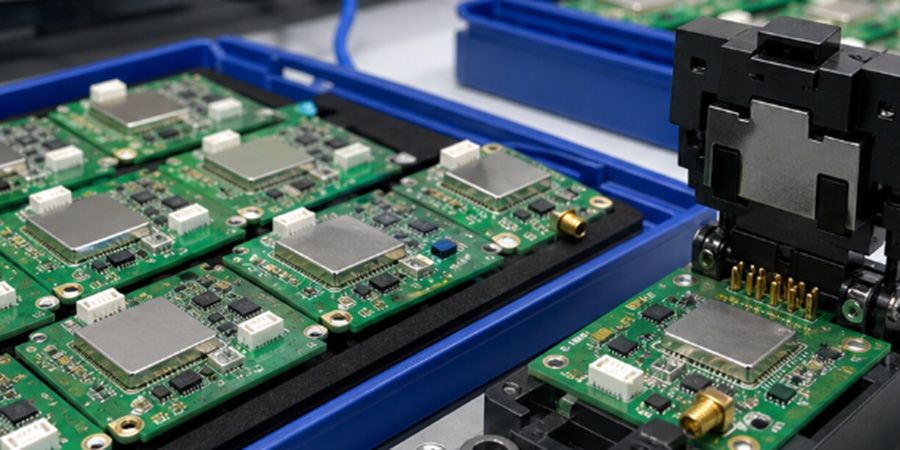
Why Component Shortages Hit PCB Builds First
Most engineers think the bare board is the long pole. In our assembly house the bare FR4 board arrives in 5 to 7 working days. The components are the bottleneck. A 0201 resistor is cheap, but when a single capacitor line in a fab goes down, the open market price triples within 48 hours. We track this weekly on a shared spreadsheet.
The root cause is concentration. A small group of foundries makes the analog and power parts that sit on every electronic components PCB. When demand spikes for one segment, like automotive grade MCUs, the same wafer capacity is pulled away from industrial and consumer lines. That is why lead times for a common 32 bit MCU moved from 12 weeks to 52 weeks in 2021 and stayed above 30 weeks through 2023. The bare board never moved more than a week during that window.
1. Diversify Your PCB Component Suppliers
Geographic Diversification
Partner with PCB manufacturers in multiple regions, for example Asia, Europe, and North America, to reduce reliance on a single market and mitigate risks from geopolitical issues or natural disasters. We run a split of 60 percent Asia sourced, 25 percent Europe, and 15 percent North America for our recurring builds. The goal is not an equal spread. The goal is that no single port closure removes more than 40 percent of a critical line item.
One practice we use is to qualify the same component at two regional distributors before production begins. Qualification takes about two weeks and costs a few hundred dollars in test coupons. It pays back the first time a typhoon shuts a hub for ten days. We also keep a second source for the long lead items on the sourcing guide at Ultimate Guide for Electronics Manufacturers: How to Source High-Quality Electronic Components PCB so the procurement team has a ready path when the primary goes dark.
Tiered Supplier Network
Maintain a mix of primary and secondary suppliers. Secondary suppliers can step in if your primary partner faces delays. We keep a primary and two backup sources for any part that represents more than 3 percent of a board's bill of materials value. For a typical 4 layer controller the active ICs are the watch items. Passives we buy in bulk and buffer because they are cheap to store.
A tiered network only works if you share forecasts. We send a rolling 8 week forecast to all three tiers every Monday. That keeps their allocation math honest and gives us a real number when we ask for a rush pull in. The mistake we see is companies that treat backups as a secret. If the backup never sees your volume, they will not hold capacity for you when the primary fails.
2. Predictive Inventory Management
Demand Forecasting
Use historical production data and market trends to predict PCB component needs, allowing you to stock up on critical parts before shortages hit. In our planning room the model is simple. We take the last 12 months of build volume, apply a seasonality factor of 0.8 to 1.3 by quarter, and add a new program ramp curve. The output feeds a weekly buy signal.
The failure mode here is the bullwhip. A small forecast bump at the OEM becomes a large order at the distributor. We cap our own forecast uplift at 15 percent per month to avoid poisoning the signal. When a customer insists on a 40 percent jump, we ask for a deposit on the extra stock. That converts a vague hope into a real commitment.
Safety Stock
Keep 2 to 4 weeks of safety stock for high demand electronic components PCB to cover unexpected delays. We set the buffer by part criticality. A unique FPGA gets 6 weeks of cover. A jellybean op amp gets 2 weeks because it is easy to replace. The stock sits in a climate controlled cage at 22 Celsius and 40 percent relative humidity to protect moisture sensitive packages.
Do not forget the shelf life. MSD level 3 parts must be baked before use if they sit more than 168 hours outside the dry pack. We log the out of bag time on a sticker for every reel. For cost shaped programs we balance this buffer against the guidance in Cost Optimization for Electronics Manufacturers: Cut Electronic Components PCB Expenses Without Sacrificing Quality so the safety stock does not quietly eat the margin.
3. Flexible Design and Material Alternatives
Design for Flexibility
Create PCB layouts that support alternative components or materials, for example FR-4 as a backup for high frequency Rogers materials, to quickly adapt to shortages. On a 10 GHz radio board we keep the impedance stackup valid for both Rogers 4350B and standard FR-4 by holding the dielectric thickness at 0.2 mm and the trace width at 0.3 mm. The insertion loss is worse on FR-4, about 0.4 dB per inch versus 0.15 dB, but the board still passes the link budget by a margin of 2 dB.
Pin compatible second sources are the other lever. We place a footprint that accepts two MCU packages with the same pitch of 0.5 mm. The bill of materials lists the alternate as a secondary line so procurement can swap without a layout spin. That single move saved a drone customer in 2023 when their primary MCU went to 45 weeks.
Early Supplier Collaboration
Work with PCB suppliers during the design phase to identify potential component risks and find viable alternatives. In our shop the mechanical and sourcing reviews happen at the schematic stage, not after the first prototype. We flag any part with a lifecycle status of NRND or a lead time above 20 weeks. Last year that check removed 11 parts from a medical board before they became a problem. We document the quality angle of this handoff in Quality Control for Electronics Manufacturers: Ensuring Reliable Electronic Components PCB Production because incoming inspection and early sourcing share the same data feed.
Common Pitfall: Single Sourced Silkscreen and Stencil
A mistake we see often is trusting one silkscreen and one stencil vendor for a whole product family. When that vendor had a fire in 2022, three of our customers lost their stencils for two weeks. We now keep a mirrored stencil file and a second vendor on a 4 day turn. The extra cost is about 60 dollars per stencil and it removes a hidden single point of failure. The same logic applies to the solder paste. We keep two pastes with the same alloy of SAC305 and the same particle size type 3 so a paste shortage never stops a line.
How Lead Times Actually Move
Lead time is not a fixed number. It is a queue. When a fab runs at 90 percent load, a new order waits two weeks. At 110 percent load the wait grows non linearly because the fab adds Saturday shifts and still falls behind. We watch the published utilization of the big OSAT houses. When utilization crosses 95 percent, we pre buy the parts with the longest tail. This is not panic buying. It is reading the queue before it forms.
Another hidden driver is the test capacity at the component house. A part can be built in four weeks but sit three more weeks waiting for final test. We ask suppliers for the test lead time separately from the build lead time. The two numbers tell a different story and the test number is usually the one that bites.
Contract Terms That Build Resilience
We add three clauses to every supply agreement. First, a right of first refusal on allocation, so our volume is cut last when the fab rations. Second, a 30 day price hold, so a spot spike cannot be passed to us inside the window. Third, a shared inventory flag, where the supplier tells us when our part drops below a safety threshold. These are normal in automotive but rare in consumer. We push them for every line above 5,000 boards per year.
A Practical Resilience Checklist
Map your bill of materials and mark every part above 3 percent of value as a watch list item.
Qualify at least two distributors per watch list part before the build starts.
Hold 2 to 4 weeks of safety stock for high runners and 6 weeks for unique ICs.
Store moisture sensitive devices at 22 Celsius and 40 percent humidity, and log out of bag time.
Send a rolling 8 week forecast to all tiers every week.
Keep mirrored stencil and stackup files with a second vendor on a 4 day turn.
Run a lifecycle and lead time scan at schematic freeze, not at prototype.
Ask for build lead time and test lead time as two separate numbers.
How We Run It on the Floor
Our global network of PCB manufacturing facilities ensures stable supply of electronic components PCB for electronics manufacturers, even during disruptions. The scheduling team meets at 9 am. They review the open shortage board, which lists every part with stock below the reorder point. Any line in red gets a phone call before lunch. This is manual on purpose. A dashboard hides nuance. A call surfaces the truth about allocation.
Contact us to discuss your supply chain needs. We can mirror your bill of materials against our approved vendor list and show you the gap in days, not in vague risk language.
FAQ
Q: How much safety stock is enough for a new product with no history?A: Start with 4 weeks of cover on every unique active part and 2 weeks on passives. Replace the guess with real build data after the first three runs. For a board with a long lead FPGA, push to 8 weeks before the pilot lot so a single allocation event cannot stop the validation.
Q: Is geographic diversification worth the extra freight cost?A: Usually yes for any annual volume above 5,000 boards. Air freight from a second region costs roughly 3 to 5 percent of bill of materials value but it prevents a 100 percent line stop. We model the freight against the cost of one week of downtime, which for most lines exceeds 20,000 dollars.
Q: What is the fastest way to de risk an existing design?A: Run a second source scan on the top five cost items and the top five lead time items. Those ten parts account for most shortage exposure. Swapping one of them to a pin compatible alternate can cut your risk by half without a layout change.
