
 Electronics Design & Development
 PCB Design & Layout Services
 PCB Fabrication & Prototyping
 PCB Assembly & PCBA Services





7 Pro Tips to Optimize Your Electronic Circuit Board Design for Performance & Reliability
A well-designed electronic circuit board is critical for the performance and reliability of your electronic pcb circuit. Whether you’re designing a simple consumer device or a complex industrial system, following these expert tips will help you create an electronic circuit board that meets your technical requirements and exceeds expectations.
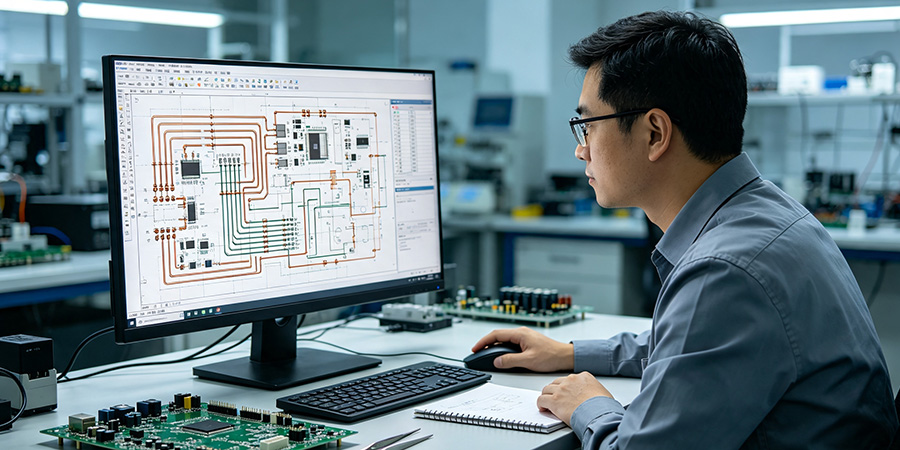
1. Prioritize Signal Integrity in Electronic PCB Circuit
Signal integrity issues, such as crosstalk and impedance mismatch, can degrade the performance of your electronic circuit board. To avoid this:
Separate high-speed signals from low-speed signals on your electronic pcb circuit.
Use controlled impedance traces for high-frequency signals to maintain signal quality.
Add ground planes to reduce noise and improve signal shielding.
2. Optimize Component Placement
Strategic component placement on your electronic circuit board can reduce assembly errors, improve heat dissipation, and simplify testing. Group components by function—for example, place power supply components near the input connector and signal processing components together. Keep sensitive components away from high-noise areas, such as power regulators or motors.
3. Implement Effective Thermal Management
Overheating can cause electronic components PCB to fail prematurely. To manage heat on your electronic circuit board:
Use heat sinks or thermal vias for high-power components like microprocessors or power transistors.
Place heat-generating components away from heat-sensitive parts like sensors or capacitors.
Choose components with higher temperature ratings if your electronic pcb circuit operates in extreme environments.
4. Minimize Electromagnetic Interference (EMI)
EMI can disrupt the performance of your electronic circuit board and cause compliance issues with regulatory standards like FCC or CE. To reduce EMI:
Use shielded cables for high-speed signals on your electronic pcb circuit.
Add decoupling capacitors near power pins of integrated circuits to filter noise.
Design your electronic circuit board with a solid ground plane to provide a low-impedance return path for signals.
5. Simplify Testing & Debugging
Design your electronic circuit board with test points and clear labeling to make debugging easier. Add access holes for probes and include a test header for in-circuit testing (ICT). This reduces the time and cost of troubleshooting your electronic pcb circuit during production and field service.
6. Choose the Right PCB Material
The material of your electronic circuit board impacts its performance, cost, and durability. FR-4 is the most common material for general-purpose electronic pcb circuit, while aluminum PCBs are ideal for high-power applications that require excellent heat dissipation. For high-frequency electronic circuit board, consider Rogers material for better signal integrity.
7. Follow Design for Manufacturability (DFM) Guidelines
Work closely with your electronic components PCB supplier to ensure your design is optimized for manufacturing. Avoid tight trace spacing, small hole sizes, and complex layouts that can increase production costs and lead times. Most suppliers offer free DFM reviews to identify and resolve design issues before production.
Conclusion: By following these pro tips, you can optimize your electronic circuit board design for performance, reliability, and manufacturability. Whether you’re a beginner or an experienced engineer, these strategies will help you create an electronic pcb circuit that meets your project’s technical and budgetary requirements.
