
 Electronics Design & Development
 PCB Design & Layout Services
 PCB Fabrication & Prototyping
 PCB Assembly & PCBA Services





MSL Handling in SMT Assembly: Floor Life, Dry Storage and Bake Decisions
MSL Handling in SMT Assembly: Floor Life, Dry Storage and Bake Decisions
A reel of components is opened at receiving, used for part of a build, and then returned to the shelf. If nobody records when the moisture barrier bag was opened, the next shift may not know whether the remaining parts are still within their allowed exposure time. That small gap in material control can turn into a package-reliability problem during reflow.
1. MSL is a package classification, not a generic component property
Moisture Sensitivity Level (MSL) indicates how a moisture-sensitive surface-mount package must be handled before solder reflow. The component manufacturer assigns the classification using the applicable moisture/reflow sensitivity procedure. The handling, packing, shipping and use requirements are covered by IPC/JEDEC J-STD-033. Always check the label and the current component datasheet rather than assuming that two parts in the same package size have the same MSL.
Moisture diffuses into package materials during exposure to ambient humidity. During reflow, the absorbed moisture expands rapidly while the package is heated. The combination of moisture pressure, material mismatch and interface degradation can cause internal cracking or delamination. Some damage is not visible from the outside.
2. The floor-life clock needs a clear start time
For a dry-packed component, the exposure record starts when the moisture barrier bag is opened. Record the opening time, MSL, temperature/humidity conditions, quantity issued to the line and any return-to-storage event. If the reel is split between several work orders, the remaining quantity still needs a traceable exposure record.
A commonly used reference example is MSL 3 with a 168-hour floor life under the specified 30°C / 60% RH condition. That example is not a substitute for the actual label, standard revision or component supplier instructions. Higher MSL levels have shorter allowed exposure periods, and the permitted time changes with the conditions defined by the standard.
3. The dry pack is a system
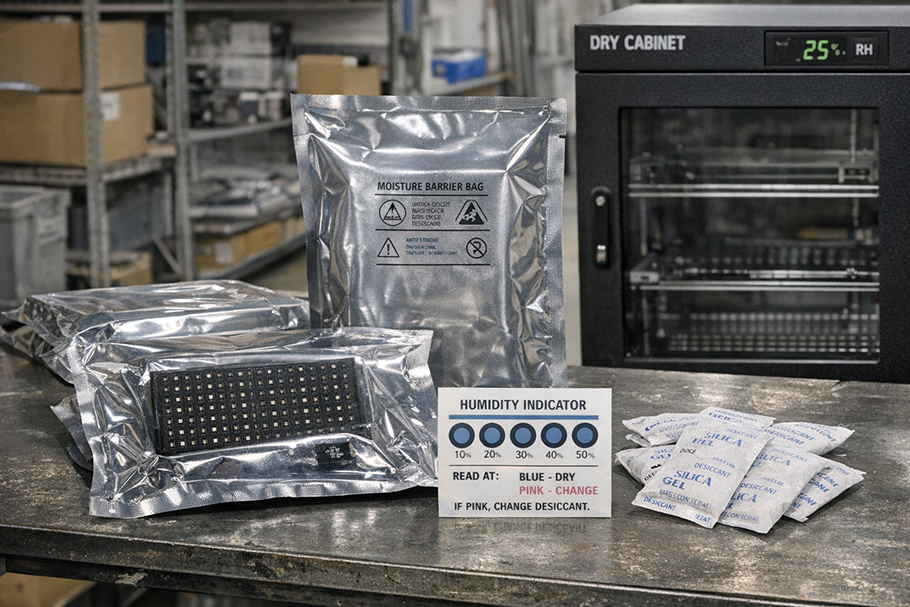
A moisture barrier bag, desiccant, humidity indicator card and sealed label work together. When a bag arrives, inspect the seal and label before opening. After opening, check the humidity indicator card and compare it with the supplier's acceptance instructions. If the card indicates an out-of-limit condition, do not quietly put the reel into production and hope the reflow profile will solve it.
A dry cabinet can pause or control exposure only when its humidity condition meets the applicable handling rules. Record the cabinet ID or storage location, the time placed into storage and the time removed. A cabinet with an unverified humidity display is not a reliable material-control system.
4. Do not bake components by habit
Baking may be required when the allowed floor life has been exceeded, but the correct temperature and duration depend on the package, thickness, carrier and supplier instructions. A tape-and-reel carrier, tray or plastic tube may have a lower temperature limit than the component package itself. Baking a whole reel at a generic temperature can deform the carrier or damage the material.
Before baking, confirm the package data, the applicable J-STD-033 table, the carrier's temperature rating and whether the component manufacturer permits the proposed treatment. After baking, restart or reset the exposure record exactly as the procedure requires. Do not assume that a bake automatically restores every component to a new, unlimited floor life.
5. Keep control at the SMT line, not just in the warehouse
| Production situation | Control to apply | Record to retain |
|---|---|---|
| New dry pack opened | Check label and humidity indicator; record opening time | MSL, bag ID, operator, date and time |
| Partial reel returned | Re-seal or place into qualified dry storage according to procedure | Remaining quantity and accumulated exposure |
| Line-side staging | Issue only the quantity needed for the planned run | Line, work order and start/stop time |
| Exposure limit exceeded | Hold the material and assess bake or disposition | Engineering approval and treatment history |
| Shift handover | Transfer the exposure status with the material | Updated floor-life balance |
A good PCBA supplier should be able to explain how MSL status follows a reel from incoming inspection to placement. Ask how the team handles partial reels, shift changes, expired floor life and baking records. The answer tells you more about process discipline than a photograph of a dry cabinet.
Review SMT Material Control with FYPCB
If your BOM includes moisture-sensitive ICs, send the component list and assembly requirements with the RFQ. FYPCB can discuss the material-handling and assembly scope through its PCB Assembly & PCBA Services
