
 Electronics Design & Development
 PCB Design & Layout Services
 PCB Fabrication & Prototyping
 PCB Assembly & PCBA Services





Automated PCB Assembly: How AI & Robotics Are Revolutionizing Electronics Production
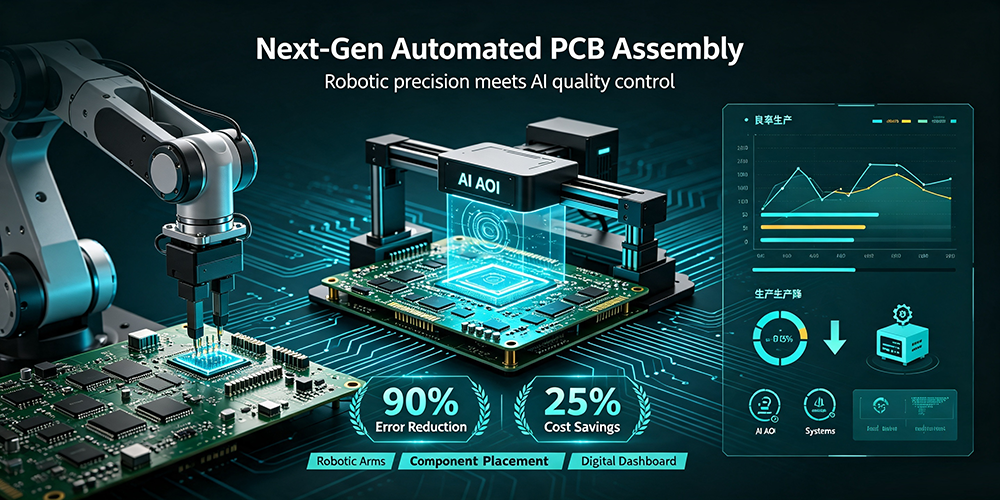
Electronics manufacturing is undergoing a automation revolution, driven by advances in artificial intelligence (AI) and robotics. Traditional manual PCB assembly processes are slow, error-prone, and costly, especially for complex PCBs with fine-pitch components and high-density layouts. Automated PCB assembly with AI and robotics offers a solution by increasing production speed, reducing errors, and lowering costs. Below are 4 ways AI and robotics are revolutionizing PCB assembly and transforming electronics production.
1. AI-Powered Component Placement & Alignment
Traditional SMT component placement relies on pre-programmed coordinates, which can lead to alignment errors if components are slightly misaligned or if the PCB warps during production. AI-powered component placement systems use machine vision and machine learning algorithms to adjust placement coordinates in real time, ensuring precise alignment even for fine-pitch components (0.3mm pitch and smaller). A South Korean consumer electronics manufacturer reduced component placement errors by 90% by switching to AI-powered placement systems, eliminating costly rework and scrap.
2. Robotic Soldering & Inspection
Manual soldering is slow and inconsistent, leading to defects like cold joints, solder bridges, and insufficient solder. Robotic soldering systems use precision robots with temperature-controlled soldering irons to produce consistent, high-quality solder joints. AI-powered inspection systems then use machine vision to inspect every solder joint, detecting defects with 99.9% accuracy. A German industrial automation supplier reduced soldering defects by 85% by implementing robotic soldering and AI inspection, reducing rework costs by $300,000 annually.
3. Real-Time Production Optimization with AI Analytics
Traditional PCB assembly lines operate with fixed production schedules, which can lead to bottlenecks and inefficiencies if there are unexpected delays or quality issues. AI-powered production analytics systems monitor real-time production data, including machine performance, defect rates, and component availability, to optimize production schedules and reduce bottlenecks. A Japanese automotive electronics supplier increased production throughput by 20% by using AI analytics to optimize their assembly line schedules, reducing lead times from 5 days to 4 days.
4. Collaborative Robots (Cobots) for Flexible Assembly
Traditional automated assembly lines are inflexible, requiring significant reconfiguration to produce different PCB designs. Collaborative robots (cobots) work alongside human technicians to handle flexible assembly tasks, including component loading, PCB handling, and testing. Cobots can be quickly reprogrammed to handle different PCB designs, reducing changeover times from hours to minutes. A US-based contract manufacturer reduced changeover times by 75% by using cobots in their assembly lines, allowing them to produce small batches of custom PCBs efficiently.
Case Study: AI & Robotics Transform PCB Assembly for Medical Devices
A Canadian medical device manufacturer was struggling with high rework costs and long lead times due to manual PCB assembly processes. They implemented automated PCB assembly with AI and robotics and achieved the following results:
Assembly Errors Reduced by 92%: AI-powered placement and inspection systems eliminated most manual assembly errors.
Production Costs Reduced by 25%: Automated processes reduced labor costs and rework expenses, saving $500,000 annually.
Time-to-Market Accelerated by 30%: Faster production and reduced changeover times allowed them to launch new products 30% faster.
Conclusion
Automated PCB assembly with AI and robotics is revolutionizing electronics production by increasing speed, reducing errors, and lowering costs. From AI-powered component placement to robotic soldering and real-time production optimization, these technologies offer significant benefits for electronics manufacturers. For companies looking to improve production efficiency, product quality, and time-to-market, automated PCB assembly is the future of electronics manufacturing. When selecting an automated assembly vendor, look for a partner with expertise in AI and robotics, proven track record in your industry, and flexible solutions that can adapt to your production needs.
