
 Electronics Design & Development
 PCB Design & Layout Services
 PCB Fabrication & Prototyping
 PCB Assembly & PCBA Services





Controlling Hardware NPI Costs: Strategic Sourcing for PCB Layout and Short-Run Assembly
For B2B procurement managers, hardware startup founders, and R&D directors, managing capital budgets while accelerating product development is a constant balancing act. Sourcing decisions often focus heavily on piece-part unit prices, while overlooking hidden expenses associated with unexpected engineering change orders, scrapped prototype boards, extended lead times, and component line shortages.
Achieving true cost control during the New Product Introduction phase requires evaluating the Total Cost of Ownership across the entire development lifecycle. Partnering with a commercially aligned pcb design and layout company that coordinates directly with a flexible low volume pcb assembly supplier allows procurement teams to eliminate unnecessary manufacturing expenses long before volume production begins.

Key Layout Cost Drivers and Front-End Optimization
Decisions made during the physical PCB layout phase directly dictate downstream fabrication and assembly costs. Identifying and addressing major cost drivers early prevents budget overruns.
1. Layer Count vs. Routing Density Optimization
While adding signal layers simplifies trace routing, each additional layer pair requires extra copper-clad laminate sheets, prepreg material, press cycles, and drilling time. Experienced layout engineers optimize BGA escape routing to keep layer counts as lean as possible, avoiding unnecessary board fabrication surcharges.
2. Via Architecture Selection
Standard through-hole vias drilled through the entire board stack remain the most economical option. Introducing blind or buried vias requires additional lamination passes and precise laser drilling, which drives up production costs. Layout specialists reserve microvias and Via-in-Pad technology specifically for high-density areas where space constraints leave no alternative.
3. Smart Panelization Strategy
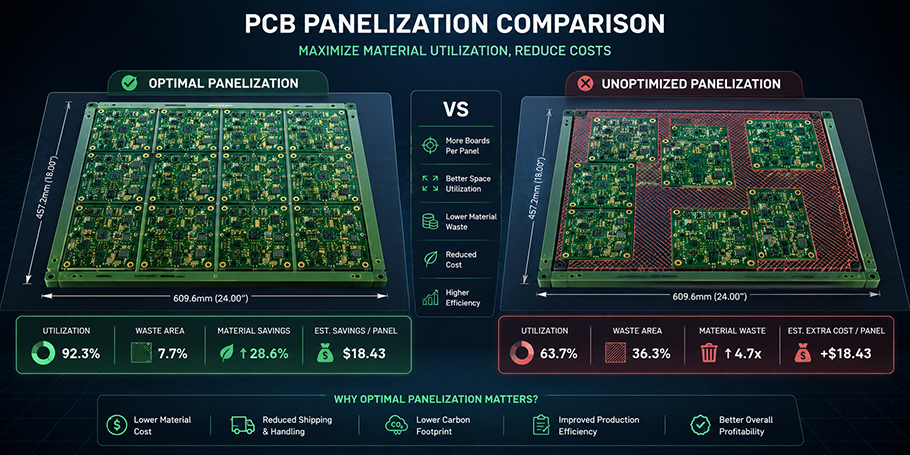
Bare board fabricators process circuit boards on large standard panel sheets, typically 18 by 24 inches. Poorly planned board dimensions lead to high material waste, which fabricators factor directly into piece prices. Layout engineers work closely with production specialists to establish array panel dimensions that maximize sheet utilization above 85 percent, lowering bare board unit costs.
Driving Efficiency Through Integrated Sourcing Models
When layout engineering and assembly operations work under a unified strategy, procurement teams avoid common supply chain traps that stall short-run production.
Automated Bill of Materials Scrubbing
Before locking in a final layout, engineers run automated Bill of Materials checks against real-time distributor inventories via live APIs. This step identifies End-of-Life components, flags parts with long lead times, and highlights allocated integrated circuits early. Proactively integrating approved alternative footprints onto the board prevents costly design revisions right before production.
Flexible Assembly Options: Turnkey vs. Consigned
A versatile low volume pcb assembly supplier offers flexible component sourcing options. Procurement teams can supply proprietary, specialized microcontrollers (consigned) while relying on the assembly supplier's purchasing power to source common passive components, connectors, and power management ICs through authorized franchise channels (turnkey).
Total Cost of Ownership: Beyond Initial Piece Prices
Evaluating manufacturing partners purely on initial prototype quotes is a common procurement misstep. A cheaper prototype quote quickly becomes expensive if it results in a 30 percent component defect rate or requires two extra revision cycles due to unaddressed layout errors.
Working with an integrated layout and short-run assembly partner eliminates communication friction, reduces component waste from obsolete layouts, and dramatically shortens time-to-revenue. Delivering a fully validated product to market two months ahead of competitors creates a distinct commercial advantage that far outweighs small differences in initial prototype piece prices.
Optimize Your Electronic Hardware Costs Today
Smart hardware procurement is not about buying the cheapest board available; it is about optimizing your overall design for maximum yield, reliability, and manufacturing efficiency.
Looking to optimize your Bill of Materials and hardware prototyping costs?
Submit your design files and BOM to our engineering and procurement team today for a free cost-reduction and DFM analysis.
