
 Electronics Design & Development
 PCB Design & Layout Services
 PCB Fabrication & Prototyping
 PCB Assembly & PCBA Services





How to evaluate the manufacturing capacity of an SMT assembly plant? A comprehensive assessment guide covering equipment and processes
When seeking SMT surface-mount manufacturing services, the biggest pitfall is encountering factories that offer low quotes and fast delivery times, only to discover numerous defects upon receiving the boards—miswelding, misalignment, bridging, and significant yield variations between batches. Quality issues in SMT assembly are often irreversible; defective boards installed in products require costly repairs and prolonged resolution periods.
How to assess the processing capacity of an SMT factory before collaboration? Fan Yi Circuit's SMT production line handles a large volume of orders daily; below are the key criteria for evaluating an SMT assembly facility.
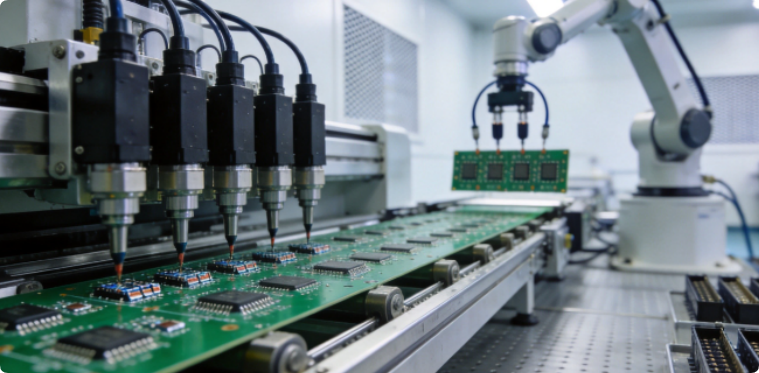
Device Overview: Compatible Products
The equipment configuration of an SMT production line determines the types of products it can process. First, consider the placement machine: its mounting accuracy dictates the device density that can be processed—only machines with an accuracy within ±0.05 mm are suitable for precision components (e.g., 0.3-mm BGA packages); placement speed affects production capacity, but faster machines don't necessarily offer higher accuracy; both factors must be balanced.
Next, consider the steel screen printing equipment: fully automatic visual alignment steel screen printers offer significantly higher precision than manual or semi-automatic systems, effectively reducing welding issues caused by offset in solder paste application.
Temperature uniformity and control accuracy are critical factors in reflow soldering furnaces. A high-quality furnace maintains temperature control precision within ±2°C across all zones, ensures uniform airflow distribution, minimizes surface temperature variations on PCBs, and guarantees consistent soldering quality across different batches.
AOI (Automatic Optical Inspection) and X-ray inspection are essential quality assurance tools. AOI detects visible welding defects such as insufficient solder, bridging, or vertical solder joints, while X-ray inspection assesses the internal quality of bottom solder joints like BGA components, identifying issues such as voids or poor solder joints.
Review the process: Check if the process documents are complete
Advanced equipment does not necessarily indicate superior manufacturing processes; it also depends on the factory's process control capabilities. A standardized SMT facility maintains a comprehensive set of process documentation, including specifications for steel mesh aperture dimensions, furnace temperature curve settings, solder paste brands and usage guidelines, as well as AOI inspection standards.
The key questions are as follows: Are the steel mesh openings manufactured in accordance with standard specifications or are the drawings drawn arbitrarily? How is the furnace temperature curve determined, and is there flexibility to adjust it based on product type? Do different components (e.g., lead-containing and lead-free) require distinct furnace temperature curves? What are the AOI inspection thresholds set, and are these standards relaxed to improve yield rates?
Management Overview: Batch Traceability and Abnormal Handling Capabilities
Abnormalities are inevitable during SMT chip mounting processes, and a standardized management system can minimize such losses. Two key aspects must be emphasized: batch traceability capabilities and an abnormal response mechanism.
Batch traceability enables comprehensive recording of production data for every batch, spanning from PCB raw materials and solder paste batches to furnace temperature curve records and mounting coordinate files. In case of issues, it allows precise identification of the specific stage where problems occurred. Standardized manufacturing facilities retain production records for at least one year.
The abnormal response mechanism describes how a factory handles issues when they arise. A good factory proactively reports problems, analyzes causes, and proposes solutions rather than concealing issues or shirking responsibility.
View Delivery: Historical Yield and Delivery Performance
If possible, review the factory's historical yield data. Reputable manufacturers typically maintain detailed yield statistics, and the batch yield for standard SMT assembly should exceed 98%. If the yield figures are significantly lower than expected or the manufacturer refuses to provide them, this may indicate falsified data.
You should also monitor delivery performance: whether promised deadlines are met and how well urgent orders are handled. A factory with frequent delivery delays, even if its products are of good quality, can pose risks to your supply chain.
View Services: Communication Response and Problem Resolution Capabilities
Finally, evaluate the factory's service attitude and communication skills. How quickly you receive a response after submitting your request, whether the response is professional, and whether the answers are clear—all these reflect service quality.
Those with the opportunity should visit the factory in person to observe the workshop's 5S management practices, equipment maintenance conditions, and operators' proficiency. What is seen firsthand is more authentic than any documentation.
