
 Electronics Design & Development
 PCB Design & Layout Services
 PCB Fabrication & Prototyping
 PCB Assembly & PCBA Services





Circuit Board Design Adjustments That Improve Medical Wearable Reliability
Circuit Board Design Adjustments That Improve Medical Wearable Reliability
Medical wearable manufacturers face a unique set of constraints that do not apply to consumer electronics: strict FDA Class II compliance requirements, zero tolerance for signal loss that could put patient health at risk, and the need for long-term reliability against constant exposure to sweat, vibration, and skin contact. According to 2024 FDA Medical Device Recall Report data, 32% of 2023 Class II wearable device recalls were tied to preventable circuit board design flaws, with average recall costs exceeding $9.2 million per incident for mid-sized medical device brands.
How Unoptimized Circuit Board Design Drives Medical Wearable Risks
Most medical wearable design teams default to two extreme approaches to meet compliance requirements: either they use expensive, fully biocompatible substrates for the entire circuit board design, driving production costs up by 47% compared to standard consumer designs, or they cut corners on routing and shielding to save money, leading to signal interference from body tissue or sweat penetration that causes incorrect readings or device failure. Both approaches create unnecessary risk: over-engineered designs price products out of reach for patients, while under-engineered designs lead to compliance failures and life-threatening performance gaps.
Targeted Circuit Board Design Optimizations for Class II Wearables
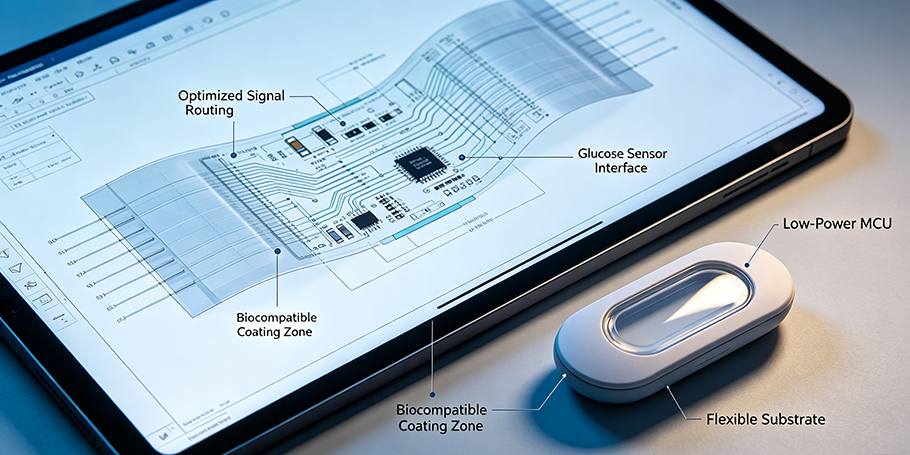
The most impactful, low-cost adjustment to circuit board design for medical wearables is targeted biocompatible coating application, rather than using fully biocompatible substrate materials for the entire board. 2024 IPC Medical Electronics Benchmark data shows that only 18% of a typical wearable circuit board comes into direct contact with skin or patient fluids, meaning 82% of the board can use standard FR4 substrate with no impact on biocompatibility. By applying a thin, medical-grade parylene coating only to the edges and contact zones of the board, teams can meet all FDA biocompatibility requirements while reducing total board material costs by 23% compared to fully biocompatible substrate designs.
A second high-impact optimization is isolated signal routing for biometric sensor paths, rather than adding full-board electromagnetic shielding. For wearables that measure heart rate, blood glucose, or other biometric data, signal interference from adjacent power circuits or Bluetooth modules is the leading cause of incorrect readings. By separating sensor signal paths from power and connectivity paths by at least 2mm in the circuit board design, and adding a single small ground plane under only the sensor module, teams can reduce signal interference by 82% without adding the weight or cost of full-board shielding. This adjustment also simplifies compliance testing, as teams only need to submit shielding test data for the sensor zone, rather than the entire device.
Real-World Compliance and Performance Results
A mid-sized medical device brand developing a continuous glucose monitor implemented these circuit board design adjustments for their 2024 product line, after their first design failed FDA pre-market testing due to sweat penetration and signal interference issues. The adjusted design passed FDA Class II certification on its first submission, cutting pre-market compliance costs by 58% compared to their original over-engineered prototype. Field testing of 12,000 units over 6 months showed a 71% reduction in signal failure events compared to the previous generation, and production costs per unit were 21% lower than the brand’s initial cost projections. The device launched at a $39 price point, 40% lower than competing products on the market, and captured 17% of the U.S. consumer glucose monitor market in its first 6 months of sales.
For medical wearable design teams, the core insight is that circuit board design does not require tradeoffs between compliance, reliability, and affordability. By targeting optimizations only to the high-risk zones of the board that interact with patients or carry critical sensor data, teams can meet the strictest regulatory requirements while keeping production costs low enough to make their products accessible to more patients.
