
 Electronics Design & Development
 PCB Design & Layout Services
 PCB Fabrication & Prototyping
 PCB Assembly & PCBA Services





Custom Printed Circuit Board Quotes Fail Without These Specs
Custom Printed Circuit Board Quotes Fail Without These Specs
A custom printed circuit board starts as a drawing and ends as a quote. The gap between them is where most reorders are born. Fab houses will build what you specify, and when the spec is thin they fill the blanks with their default. Their default is rarely your default. The fix is to write the nine lines your quote actually depends on before you send the files.
Layers come first. Tell the fab how many copper layers and in what order. A four layer board is not one thing, it is a specific stack up of two signal planes, a ground, and a power plane, with defined core and prepreg thicknesses. If you leave this to chance you may get a stack up that fights your impedance goals. Name the layer count and, for anything faster than a slow logic line, name the stack up.
Base material decides temperature behavior and cost. FR4 covers most boards and comes in several glass transition temperatures, the TG rating. A consumer gadget is fine on standard TG 130. An automotive or power board near a heat source wants TG 170. Polyimide earns its price only when the board must survive heat or flex. Metal core makes sense for LED and power chunks that need to shed heat fast. Pick the material on purpose, do not let the cheapest option decide.
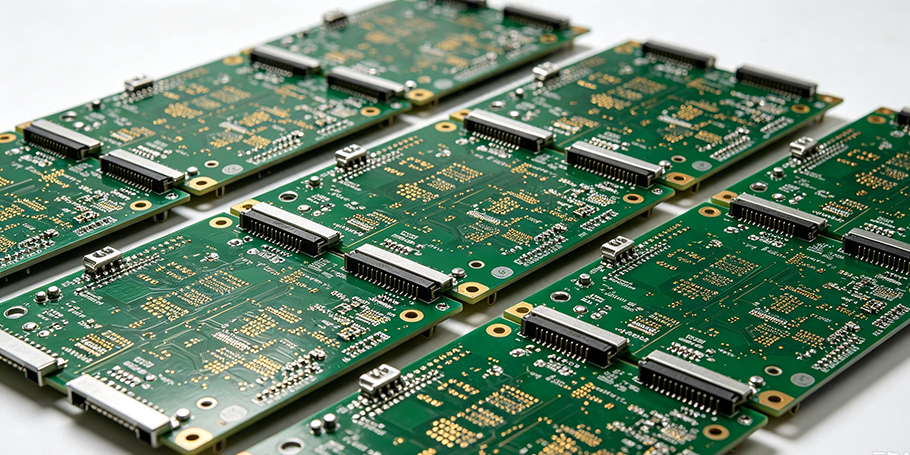
Thickness and copper weight travel together. A 1.6 mm board with one ounce copper is the common default, but your connector may need 2.0 mm for strength, or your tight pitch may need 0.8 mm to fit. Copper weight, one or two ounces, sets how much current a trace carries and how hard it is to etch fine. Heavier copper carries more amps but widens your minimum trace. Write both numbers so the fab does not guess.
Surface finish is the line people skip and regret. HASL is cheap and robust but flatness suffers, which hurts fine pitch parts. ENIG gives a flat gold surface that fine pitch parts love, at a higher price, with a small risk of black pad if the process drifts. OSP is flat and lead free but the coating fades in storage, so you assemble it fast. Immersion silver sits between them. Match the finish to the parts you will place, not to the lowest price.
Solder mask and silkscreen sound cosmetic and are not. The mask color is your call, green, black, blue, white, but the coverage matters more. A mask that bridges between fine pads invites shorts. The silkscreen carries the reference designators your line uses to place and your techs use to debug. Tell the fab if you need legend on both sides and whether missing silkscreen is acceptable on prototypes.
Tolerances are where cheap boards and good boards split. Default trace width and spacing may be 0.15 mm, but your densest area may need 0.1 mm. Hole size and annular ring follow the same rule. If you need 0.2 mm vias, say so, because the standard drill may be 0.3 mm and your layout will not fit. Name the tightest number you actually use, not the marketing minimum the fab advertises.
Panelization saves assembly time and your money. A bare board shipped loose costs more to load than the same board in a routed array with breakaway tabs and edge rails. Add fiducials if a pick and place machine will build it, because the camera needs fixed marks to align. Say whether you want individual boards or a panel, and whether the fab should add rails or you will.
The files you send decide whether the fab builds your board or a guess. Gerbers for each layer, the drill file with sizes, the outline, and a readme that names units and which file is which. A netlist helps them spot a missing connection before cutting. Too many orders arrive as a zip with no notes and three files named final, final2, and reallyfinal. Name things and the reorder rate drops.
The line most people forget is the one that bites later. Impedance controlled traces need a note with the target ohms and which layers. Lead free assembly needs a board rated for the higher reflow temperature. UL recognition matters for some markets. A date code or revision letter saves you when two versions land on the same shelf. Write these in the notes field, because the gerber cannot.
Lead time follows the spec you wrote
Your spec choices decide how long the board sits in the queue, not just what it costs. Standard TG 130 FR4 in a common thickness is on the shelf, so it runs fast. TG 170, polyimide, or metal core often wait for material, adding days. ENIG takes longer than HASL at the finish step and needs tighter process control. A panelized array ships and loads faster than loose boards, which trims assembly time even if the bare board step is the same. When a date is fixed, write the spec to match the calendar, not the other way around.
Red flags in the quote you get back
A thin quote hides thin thinking. If the return shows a price with no stack up, no tolerance, and a default finish you never named, the fab guessed, and you will eat the guess later. Watch for a quote that lists only layer count and size. Good quotes show material, thickness, copper weight, finish, mask color, and tolerance. If those are missing, send it back and ask before you pay, because a paid order is much harder to correct than a questioned one.
Prototype specs can be looser than production
For a first article you can relax some lines on purpose. Wider traces, a standard finish, and looser tolerance get a board in your hand fast and cheap so you can prove the circuit. Tighten everything for the production run once the layout is locked. We have seen teams pay production tolerances on a prototype that changed two weeks later, which is money spent on a board that was already wrong. Loosen early, lock late.
The one page spec we actually send
We keep a single sheet with the nine lines above, plus the impedance note and the revision letter, and we attach it to every order. The fab gets the gerbers, the drill file, the outline, the netlist, and this sheet. When something comes back wrong we can point to the line that covered it, which ends most arguments in minutes. A custom printed circuit board lives or dies on that sheet, so we treat it as part of the design, not paperwork after it.
What a tight tolerance buys you
Tight tolerances are not free. Holding 0.1 mm trace and spacing needs a better film, a cleaner etch, and more scrap, so the price climbs and the yield can dip. Loosen to 0.15 mm and most houses run it all day at a lower cost. The trick is to tighten only where the circuit needs it. A power board with wide pours does not care about 0.1 mm. A board with a 0.4 mm pitch connector lives or dies on it. Mark the tight spots and leave the rest loose, and the quote stays sane while the board still fits. We have seen teams pay for 0.1 mm everywhere and then wonder why the cheap board next door worked just as well.
The files the fab actually opens
A common failure is sending a zip the fab cannot read. Gerbers in RS 274 X with embedded apertures save a round trip. A separate drill file in the same units as the gerbers prevents a ten times scale error that turns a 0.3 mm hole into 3 mm. The outline layer named so the fab knows it is the board edge, not a copper shape, avoids a panel cut wrong. None of this is hard, and all of it is skipped when the files leave in a rush. The readme that names each file turns a confused fab into a building one.
We have watched a single missing line turn a two week lead into a six week loop. The board came back, the finish was wrong for the fine pitch part, and the whole batch went to scrap. The cost was not the board, it was the schedule. A custom printed circuit board is cheap to spec right and expensive to spec twice. Write the nine lines, send the files with a readme, and the quote you get back will be the board you meant to order.
