
 Electronics Design & Development
 PCB Design & Layout Services
 PCB Fabrication & Prototyping
 PCB Assembly & PCBA Services





Circuit Board Stencils Specs and Buying Notes
A circuit board stencil looks like a plain sheet of metal until you need one, and then the details decide whether your surface mount line runs or stalls. Most buying mistakes come from treating stencils as identical. They are not. The foil, the cut, the thickness, and the frame each change how the paste lands. This is a spec sheet you can carry to the order form. You reach for a stencil once a board carries parts too fine or too many to place by hand with a syringe, which for most surface mount work happens at the first QFP.
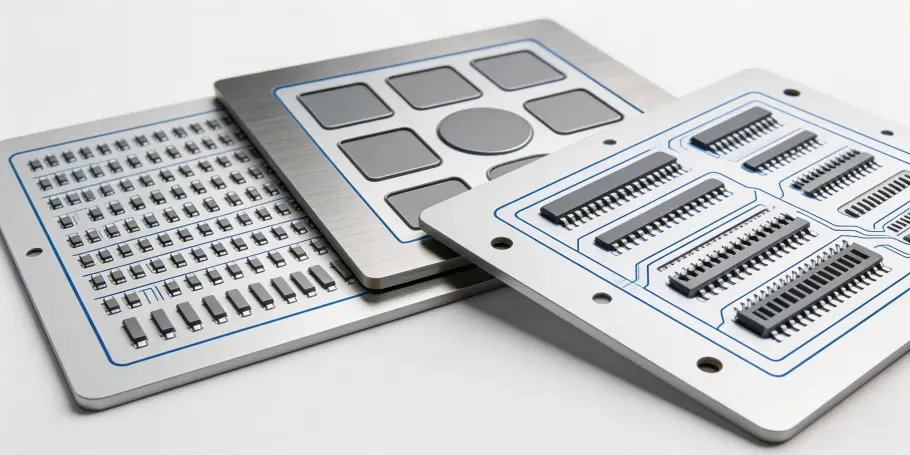
Material options
Material | Cut method | Best for | Watch out for |
Stainless steel 304 | Laser | Production runs, fine pitch | Costs more than polyimide |
Stainless steel | Chemically etched | Low cost, coarse pitch | Tapered walls trap paste |
Polyimide film | Laser | Prototypes, odd shapes | Wears fast, not for volume |
Nickel | Electroformed | Very fine pitch, tight tolerance | Expensive, long lead time |
Stainless laser cut is the default for a reason. The cut wall is near vertical, so paste releases cleanly instead of dragging. Etched foils are cheaper and fine for 1.27 mm pitch and up, but the undercut wall leaves less paste on the pad.
Thickness against pitch
Stencil thickness | Safe down to | Typical use |
0.15 mm | 0.8 mm pitch | Power boards, large passives |
0.12 mm | 0.5 mm pitch | Mixed 0805 to QFP boards |
0.10 mm | 0.4 mm pitch | Fine pitch connectors |
0.08 mm | 0.3 mm pitch | Very fine pitch, careful printing |
Pick thickness from your tightest part, not from the average board. If most of the board is coarse but one connector is 0.4 mm, you still need 0.10 mm or the aperture clogs. A step stencil, thicker in one region and thin in another, solves mixed boards but costs more and takes longer to cut.
Framed or frameless
A framed stencil sits in a fixed aluminium border under tension. It drops into the printer and stays flat. A frameless foil, sometimes called a glue stencil, sticks to a reusable frame or a polyimide border with adhesive. It is cheaper to ship and fine for low volume, but it flexes more and needs a frame on your end.
Type | Cost | Stability | Good for |
Framed stainless | Higher | High | Production, repeats |
Frameless foil | Lower | Medium | Prototypes, one offs |
Glue in reusable frame | Medium | Medium high | Small batches |
If you print the same board more than a few times, the framed version pays for itself in consistency. If this is a one board test, the frameless foil is enough.
Aperture rules that actually matter
Two ratios decide whether paste releases. The aspect ratio is aperture width divided by stencil thickness. Keep it at 1.5 or above, so a 0.12 mm stencil wants apertures at least 0.18 mm wide. The area ratio is aperture area divided by wall area. Keep it at 0.66 or above. Fall below either and paste sticks in the hole and the next print comes up short.
Most stencil houses apply these rules automatically and flag apertures that break them. Read the flag. A house that shrinks a bad aperture for you without telling you is doing you a favour you should know about, because the corrected pad may no longer match your layout exactly.
Wall angle and release
The cut wall is not perfectly vertical, and the angle decides how cleanly paste lets go. A laser cut stainless wall leans about one to two degrees, steep enough that paste releases as the squeegee passes. An etched wall leans more, sometimes five degrees or past it on the exit side, and that wider taper holds paste back so the pad gets less. Electroformed nickel is the opposite, nearly vertical and polished, which is why it prints the finest pitches, but the polish also makes it pricier and slower to make. When a house offers you a cheaper etched stencil for a fine pitch board, the wall angle is the reason to think twice.
What it costs
Prices move with size, thickness, and frame. A small frameless prototype stencil can land under twenty dollars. A framed stainless stencil for a panel runs from forty to over a hundred depending on dimensions and lead time. Rush cuts cost more and rarely print better, so order the stencil with the bare boards, not after they arrive.
Common questions
Do I need a stencil for ten boards? If the boards are hand built with large parts, a syringe works. If they carry a QFP or a fine pitch part, a stencil saves more time than it costs, even at ten units.
Can one stencil serve two boards? Only if the pad layouts match. A stencil is cut for one pattern. Two different boards need two stencils or one combined panel stencil.
How long does a stencil last? A cared for stainless stencil prints tens of thousands of times. Dried paste and kinks end it early. Clean it between runs and store it flat.
What file does the house need? The paste layer Gerber, usually the top paste file, plus the board outline. Some houses accept the full Gerber set and pull the paste layer themselves. A clean export avoids a wrong cut.
Why does my stencil print light on one corner? Usually a flatness or pressure problem. One corner of the foil is not in contact with the board, so paste skips there. Check the frame tension and the printer pressure.
Can I repair a clogged aperture? Sometimes. Apertures clogged with fresh paste clear with solvent and a wipe. Apertures where paste cured need a new stencil, because the wall is already damaged.
Do I need fiducials on the stencil? The stencil reads the board fiducials through the printer camera. The stencil itself only needs them if it is a combined panel cut from one foil.
Buying checklist
Note your finest pitch before picking thickness.
Choose laser cut stainless unless cost forces polyimide.
Pick framed if you print repeats, frameless if it is a one off.
Ask the house to report any aperture that breaks the 1.5 aspect or 0.66 area ratio.
Order the stencil with the bare boards, not after.
Confirm the paste Gerber matches the layout you sent for fabrication.
Step stencils
A step stencil carries two thicknesses in one foil. The fab cuts it thicker where large parts need more paste and thinner over fine pitch parts that would bridge with the full thickness. It is the fix for a board that mixes a power section with a tight connector, the same problem solved above by compromising on a single thickness. Step stencils cost more and need a day or two longer to cut, because the step is etched or milled into the foil after the apertures are cut. For a board you print often, the extra cost disappears against the scrap you avoid.
Storage and handling
A stencil arrives flat and should stay flat. Lean it against a wall and the foil kinks, and a kink prints a line on every board after. Keep it in its frame, wipe the underside with a lint free cloth and alcohol between runs, and do a full clean with a stencil roll at the end of the day. Humidity is the quiet enemy. Paste left on the foil overnight draws moisture and cures in the apertures, and cured paste does not come out. A stencil that is cleaned the same day it is used prints the same way a year later.
Lead time and ordering
Order the stencil with the bare boards, not after they arrive, because the cutting house needs a day for a simple foil and two or three for a framed or stepped one. Rush options exist and cost more, but they do not print better, they only ship sooner. Send the paste Gerber, usually the top paste layer, plus the board outline so the house can register the apertures. Some houses accept the full Gerber set and pull the paste layer themselves, which removes a chance for you to send the wrong file. Confirm the paste layer matches the fabrication file before you approve, because a stencil cut from an old layout prints offset by whatever changed.
The short version
A stencil is a precision tool wearing a plain face. The thickness sets your floor on pitch, the cut sets how clean the paste releases, and the frame sets how repeatable the prints stay. Spend the order form on those three and the line spends its time building boards instead of fixing them.
If the board you are stencilling came from a layout the factory can read, the apertures line up without a fight. And if you are still choosing how the bare board gets made, the file your design software exports is what the stencil house cuts from, so the clean export pays off at both ends.
