
 Electronics Design & Development
 PCB Design & Layout Services
 PCB Fabrication & Prototyping
 PCB Assembly & PCBA Services





Ordering a Printed Circuit Board: What Happens After Upload
There is no shortage of advice about preparing files before you order a printed circuit board. There is much less about what happens after you press send, and that gap is where most delays live. The boards are usually not late because someone was slow. They are late because a question came up on day one and the clock stopped while it was answered.
This is a walkthrough of a real prototype order, from upload to the box landing on your desk, with the places where time is won or lost marked along the way. If you also want to understand what each line of a quotation means, that is a separate article on this site. This one is about the timeline.
Day 0. The upload, and the first silent test
You upload a zip file and, if the system is good, you get a parsed preview within a minute or two. Underneath that preview the software is reading your layer stack, matching the drill file to the copper layers, measuring the board outline, and counting nets if the format carries them.
Everything downstream depends on that parse. A missing drill file stops it. An outline drawn on the wrong layer stops it. A drill file in the wrong units does not stop it, which is worse, because the parser may accept it and you get a quotation for a board with holes twenty five times the size you intended. Always look at the preview before you pay attention to the price.
Day 0 to 1. CAM review, where a human reads your intent
Once the files parse, an engineer looks at them. This is not a formality. The review checks the things a parser cannot judge: whether the outline is a single closed shape, whether vias have enough annular ring given the drill size, whether silkscreen sits on pads, whether copper comes too close to a routed edge, whether the plated and non plated holes are separated, and whether anything you claimed in the notes, impedance being the usual one, is actually supported by the stackup in the files.
If your board has slots, edge plating, or controlled depth milling, this is where those notes get read properly, and it is why they belong in the fabrication note rather than in an email three days later.
The clarification email is good news
People treat a question from the factory as a failure. It is the opposite. It means someone read your board before committing it to a panel, instead of guessing and building the wrong thing.
The questions are usually short and predictable. No drill file, or the drill file does not match the layers. Outline missing or drawn on a copper layer. No solder mask layer. Impedance requested with no dielectric specification. Board thickness not stated. Slots drawn but not marked plated or not. Non plated holes mixed into the plated tool list. Each one takes about four minutes to answer, and each one, unasked, costs a week.
A supplier who never asks anything is not necessarily efficient. Sometimes they are just building to their own defaults.
Day 1 to 2. Scheduling, where lead time is actually decided
After approval, the job waits for a panel slot. If your boards are pooled with other orders on a shared panel, they wait for a compatible slot. If they need a dedicated panel, because of thickness, impedance, or a special material, they wait for the line.
Two things you control make this faster. First, approve the order quickly, because the clock stops between the answer and your reply. Second, lock your specification. Changing quantity, thickness, or finish after the job is scheduled is the single most reliable way to lose several days, because the panel has to be rebuilt around the change.
If you are in a hurry
Two things genuinely help. Expedited slots pull a job forward in the queue and are priced for it, which is fair enough when the cost is somebody else's board sliding back a day. The other trick is splitting the order: send the smallest useful quantity on the fastest service so debugging can start, and put the remainder on standard turnaround. You pay the premium on five boards instead of fifty, and your firmware work gains a week.
What does not help is approving an order on Friday evening and expecting a build to have happened over the weekend. Panel scheduling, drilling, and plating run on the factory's calendar, not on yours.
Day 2 onward. The build, in brief
Inner layers are imaged and etched, inspected, then laminated with the stackup pressed into one block. Drilling comes next, then plating the barrels, then the outer layer imaging, plating, and etch. Solder mask and legend follow, then the surface finish, then electrical test, then routing and final inspection.
Each of those steps has its own article length of detail. The point for an ordering timeline is simpler: none of them start until the previous one finishes for the whole panel, so a job that enters a panel slot on day two is carried by that panel's schedule, not by yours.
Test, pack, and the part nobody photographs
Electrical testing happens before the boards leave. Flying probe testers walk probes across the nets and need no fixture, which suits prototypes. Production quantities usually justify a fixture, which is faster per board and costs money to build.
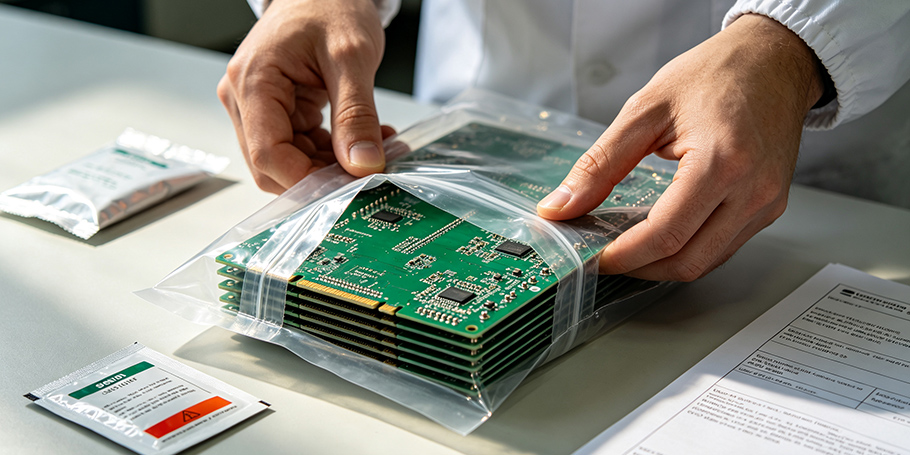
Packing is more careful than it looks. Boards are vacuum packed with desiccant and a humidity indicator, because laminate absorbs moisture and a board that sits damp will give you trouble in reflow. Corners are protected, and boards are separated with interleaving so silkscreen does not abrade in transit. If your package arrives without desiccant, note it.
Shipping, and the day tracking does not move
Couriers move fast and their tracking is not always real time. A package that sits unchanged for a day is usually in a sorting hub or waiting on customs, not lost. On international orders, duties and taxes are the receiver's job unless something else was agreed, and a missing tax number is a common reason a shipment pauses at the border. Choosing economy freight to save a little money on a prototype order is usually a bad trade, because two extra days of transit cost more than the difference.
The first ten minutes with the box
Do these before you put the boards away. Count them against the packing note. Look for bent or chipped boards and photograph anything damaged before you unpack further, because claims are much easier with a picture of the sealed package. Measure the thickness with a caliper against what you ordered, which is the fastest way to catch a wrong stackup. Check the finish and the mask colour, read a silkscreen reference or two, and look for the test coupon or the panel tab if you asked for one.
Then check the packing note against your specification: material, thickness, copper weight, finish, IPC class. If anything disagrees, say so now, while the job is fresh, rather than after you have assembled five boards.
Finally, store them properly. Bare boards absorb moisture, and a board that has sat open in a humid room for weeks can blister or delaminate in reflow. Keep the vacuum pack sealed until the boards are needed, and if a pack has been open a long time, a low temperature bake before assembly is cheap insurance.
What stalls orders, and the one line that prevents it
Stall | One line that prevents it |
Missing or mismatched drill file | Include the drill file in the same zip and check the preview |
Outline on the wrong layer | Put the closed outline on a single dedicated mechanical layer |
Impedance with no stackup | State target impedance, layer, and dielectric thickness |
Thickness not specified | Write board thickness and tolerance in the fabrication note |
Slots not marked plated or not | Add "slots plated" or "slots non plated" to the note |
Quantity or finish changed mid order | Freeze the specification before you approve |
Most delays are not manufacturing problems. They are information problems, and information is the one part of the process you control completely.
When you are ready to order a printed circuit board, upload your Gerbers and include the note above, and the first review is usually the only one. If you want to understand what each line of the quotation means before you approve it, the PCB quote breakdown covers that in detail, and the PCB circuit board design rules article lists the checks that stop an order stalling after it is placed.
