
 Electronics Design & Development
 PCB Design & Layout Services
 PCB Fabrication & Prototyping
 PCB Assembly & PCBA Services





PCB Assembly: 6 Common Mistakes That Cost You Time and Money (And How to Avoid Them)
PCB assembly is a complex process where even small mistakes can lead to significant costs, delays, and product failures. Whether you’re a startup launching your first product or an established company scaling production, avoiding common PCB assembly mistakes is critical to maintaining profitability and customer satisfaction. Below are the 6 most costly PCB assembly mistakes and actionable strategies to avoid them.
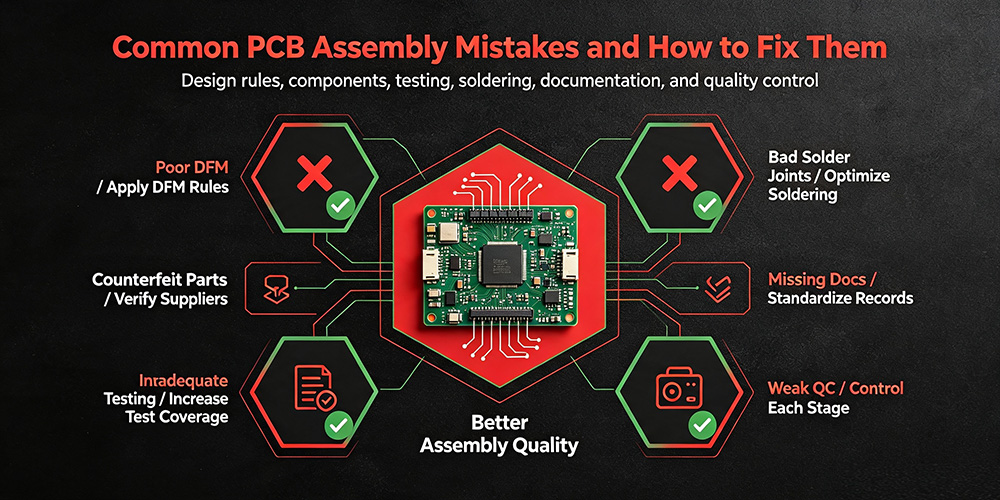
The True Cost of PCB Assembly Mistakes
A 2023 report by the Electronics Manufacturing Services Association found that PCB assembly mistakes cost the global electronics industry over $15 billion annually. These costs include:
Rework and Scrap: Up to 10% of products are scrapped or reworked due to assembly errors, costing an average of $200 per defective unit for complex electronics.
Delayed Launches: Mistakes that require rework can delay product launches by 4–8 weeks, resulting in lost market share and revenue.
Field Failures: Defects that escape inspection lead to product failures in the field, costing an average of $1,000 per failure in warranty claims and brand damage.
For medical device and aerospace companies, the costs are even higher—a single field failure can result in regulatory fines, product recalls, and damage to brand reputation.
6 Common PCB Assembly Mistakes and How to Avoid Them
1. Neglecting Design for Manufacturability (DFM) Analysis
Mistake: Skipping DFM analysis before production leads to design issues that cause assembly defects, rework, and delays. A US-based industrial IoT startup found that 70% of their assembly defects were due to poor DFM, resulting in $500,000 in rework costs during their first product launch.
2. Using Counterfeit or Low-Quality Components
Mistake: Sourcing components from untrusted suppliers increases the risk of counterfeit or low-quality parts, leading to product failures and safety hazards. A 2022 study by the International Chamber of Commerce found that 10% of electronic components sold globally are counterfeit, costing the industry $46 billion annually.
3. Inadequate Testing and Inspection
Mistake: Skipping or rushing testing and inspection leads to defects escaping into the field, resulting in warranty claims and customer complaints. A Canadian medical device manufacturer found that 30% of their field failures were due to inadequate testing during PCB assembly.Solution: Implement a comprehensive testing and inspection process that includes automated optical inspection (AOI), X-ray inspection, and functional testing. A Japanese consumer electronics supplier uses 100% automated testing for all their PCBs, reducing defect escape rates to 0.01%.
4. Poor Communication with Your PCB Assembly Vendor
Mistake: Lack of clear communication between you and your vendor leads to misunderstandings, design errors, and delayed projects. A UK-based industrial automation supplier reported that 25% of their project delays were due to miscommunication with their PCB assembly vendor.Solution: Establish a single point of contact with your vendor, provide detailed design specifications and requirements, and schedule regular check-ins to discuss project progress. A Chinese consumer electronics vendor uses a dedicated project manager for each client, reducing communication-related delays by 90%.
5. Ignoring Thermal Management in Design
Mistake: Poor thermal management in PCB design leads to overheating, component failure, and reduced product lifespan. A 2023 study by IEEE found that 50% of electronic component failures are due to overheating.Solution: Incorporate thermal management into your PCB design, including heat sinks, thermal vias, and proper component placement. A German industrial IoT supplier reduced component failure rates by 40% by implementing thermal management best practices in their PCB designs.
6. Failing to Plan for Scalability
Mistake: Designing PCBs that are difficult to scale up for mass production leads to increased costs and delays when demand grows. A US-based consumer electronics startup found that scaling production from 1,000 to 10,000 units required a complete redesign of their PCB, delaying their product launch by 3 months.Solution: Work with your PCB assembly vendor to design PCBs that are scalable for mass production. This includes using standard components, avoiding custom parts, and designing for automated assembly. A Singapore-based medical device supplier designed their PCBs for scalable production, allowing them to increase production from 500 to 50,000 units without redesigning the PCB.
Case Study: Avoiding PCB Assembly Mistakes Saves $1M Annually
A European industrial automation company was struggling with high rework costs and delayed product launches due to common PCB assembly mistakes. They implemented the following changes:
Mandatory DFM Analysis: Reduced assembly defects by 80%, saving $400,000 annually in rework costs.
Trusted Component Sourcing: Eliminated counterfeit components, reducing field failure rates by 30% and saving $300,000 in warranty claims.
Comprehensive Testing: Reduced defect escape rates to 0.02%, saving $200,000 in brand damage and customer retention costs.
Clear Communication: Reduced project delays by 25%, saving $100,000 in lost revenue.
Total annual savings: $1,000,000.
Conclusion
Avoiding common PCB assembly mistakes is critical to reducing costs, accelerating time-to-market, and improving product reliability. By implementing DFM analysis, sourcing components from trusted suppliers, conducting comprehensive testing, maintaining clear communication with your vendor, incorporating thermal management, and planning for scalability, you can avoid costly mistakes and ensure efficient, successful electronics manufacturing. When partnering with a PCB assembly vendor, choose one that offers expertise in these areas and can help you navigate the complexities of PCB assembly to achieve your business goals.
