
 Electronics Design & Development
 PCB Design & Layout Services
 PCB Fabrication & Prototyping
 PCB Assembly & PCBA Services





The Future of PCB Assembly: AI-Powered Capabilities Transforming Electronics Manufacturing
The future of PCB assembly is driven by AI-powered capabilities that enhance efficiency, quality, and scalability. Advanced suppliers are integrating AI into every stage of assembly, from design to testing, transforming the electronics manufacturing industry.
AI-Assisted PCB Design for Improved Manufacturability
AI-powered PCB assembly capability starts with design. AI tools analyze PCB designs to optimize component placement, trace routing, and solder mask application, reducing assembly defects by 30%. A US-based PCB assembly supplier uses AI to generate optimized designs for industrial PCBs, cutting design time by 50% compared to manual processes. The AI system also flags potential manufacturability issues like tight component spacing or incompatible solder mask openings, eliminating 90% of pre-production reworks for their clients.
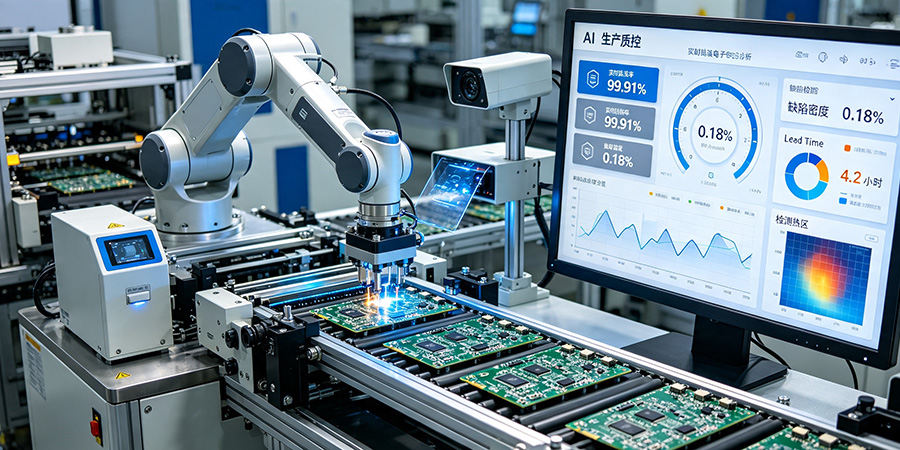
AI-Powered SMT Assembly for Real-Time Adjustments
AI is transforming SMT assembly by enabling real-time adjustments to production lines. AI algorithms analyze assembly data to detect component misalignment or solder defects, automatically adjusting machine settings to correct issues. A Chinese PCB assembly supplier uses AI to adjust pick-and-place machine speeds based on component type, improving assembly efficiency by 25% while maintaining quality. For delicate components like 0201 resistors, the AI slows the machine to ensure precise placement, while for larger connectors, it speeds up production to meet high-volume targets.
AI-Driven Quality Control for Defect Detection
AI-powered inspection systems are more accurate and faster than manual inspection. Suppliers with advanced PCB assembly capability use AI-powered AOI to detect defects with 99.9% accuracy, reducing false positives by 40%. A European PCB assembly supplier inspects 15,000 PCBs daily with AI, ensuring no faulty boards reach customers. The AI system can even identify subtle defects like micro-cracks in solder joints that human inspectors miss, improving product reliability for medical and aerospace applications.
Predictive Maintenance for Uninterrupted Production
AI helps suppliers maintain production lines by predicting equipment failures before they occur. AI algorithms analyze machine data to identify potential issues, allowing maintenance teams to address them proactively. A Japanese PCB assembly supplier specializing in automotive electronics uses AI-powered sensor data to monitor SMT line equipment, predicting 95% of potential failures 72 hours in advance. This proactive approach reduced unplanned downtime by 40% and cut annual maintenance costs by $2.3 million, ensuring uninterrupted production for their IATF 16949-certified automotive PCB projects. By eliminating unexpected line stops, the supplier maintains consistent lead times even during peak production seasons.
AI-Optimized Component Sourcing for Supply Chain Resilience
Global supply chain disruptions have become a major challenge for PCB assembly, but AI-powered capability is transforming how suppliers manage component sourcing. AI algorithms analyze real-time data from global component markets, including stock levels, lead times, and geopolitical risks, to predict shortages and price fluctuations. A German industrial PCB assembly supplier uses this technology to secure critical components like high-temperature capacitors and ruggedized connectors 3 months in advance, reducing supply chain delays by 35% compared to traditional sourcing methods. This not only ensures on-time production but also locks in competitive pricing, passing 15% cost savings to their industrial automation clients.
Smart Factory Integration for End-to-End Automation
The ultimate evolution of AI-powered PCB assembly capability is the fully integrated smart factory, where AI orchestrates every stage of production from design to shipping. In these facilities, AI systems communicate seamlessly with SMT machines, inspection tools, and logistics platforms to optimize workflows in real time. A South Korean PCB assembly supplier operates a smart factory for consumer electronics, where AI adjusts production schedules based on customer demand, optimizes component placement to reduce waste, and even autonomously routes finished PCBs to shipping. This level of integration has increased production efficiency by 30%, reduced material waste by 20%, and achieved a 99.9% first-pass yield for their 2 million monthly PCB orders.
Conclusion: AI-powered PCB assembly capability is not just a future trend—it’s a present-day solution that delivers tangible improvements in efficiency, quality, and supply chain resilience. By integrating AI into design, assembly, quality control, and sourcing, forward-thinking suppliers are setting new standards for the electronics manufacturing industry. For businesses in industrial, automotive, or consumer electronics sectors, partnering with a supplier that leverages AI technology is critical to staying competitive, reducing risks, and delivering high-quality products to market faster. As AI continues to advance, the future of PCB assembly will become even more automated, sustainable, and customer-centric, opening new possibilities for innovation in electronics design and production.
