
 Electronics Design & Development
 PCB Design & Layout Services
 PCB Fabrication & Prototyping
 PCB Assembly & PCBA Services





Advanced PCB Assembly Capability: 7 Critical Metrics to Vet Your Supplier for Industrial Projects
In the competitive landscape of industrial electronics, partnering with a supplier with robust advanced PCB assembly capability is non-negotiable. Poor assembly quality can lead to costly product recalls, delayed market launches, and damaged brand reputation. To help you make an informed decision, below are 7 critical metrics to vet a supplier’s advanced PCB assembly and SMT assembly capability.
1. SMT Assembly Precision & Component Placement Accuracy
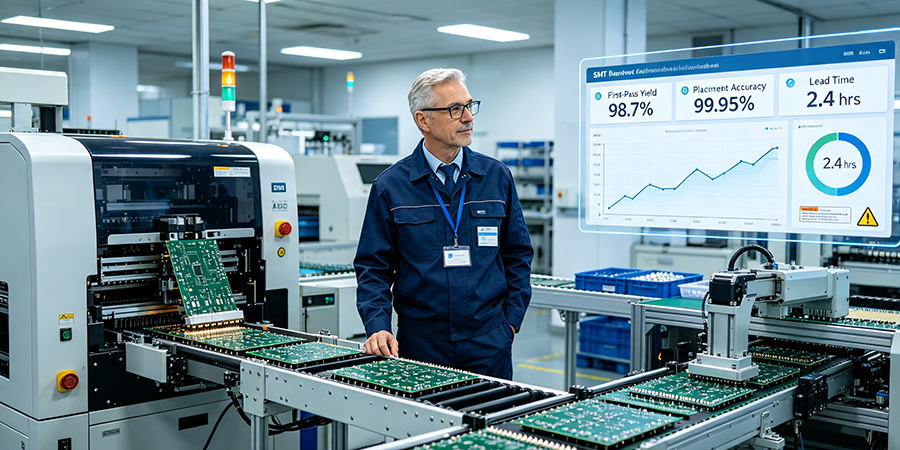
The foundation of advanced PCB assembly capability lies in SMT assembly precision. Top suppliers achieve component placement accuracy of ±0.02mm for micro-components like 0201 resistors and fine-pitch BGAs, ensuring reliable connections for high-density industrial PCBs. For example, a Shenzhen-based PCB supplier uses AI-powered pick-and-place machines to achieve 99.9% placement accuracy for automotive ADAS PCBs, reducing solder joint defects by 85% compared to traditional machines. This level of precision is critical for industrial applications where even a 0.1mm misalignment can cause system failure.
2. Complex Component Handling Expertise
Industrial projects often require complex components like 32-layer PCBs, high-frequency RF boards, and aluminum-backed heat sinks. A supplier’s advanced PCB assembly capability is tested by their ability to handle these components without damage. A German PCB supplier specializes in assembling industrial motor control PCBs with high-power IGBT modules, using automated thermal paste application to ensure optimal heat dissipation. Their SMT assembly capability includes handling components with pin pitches as small as 0.3mm, meeting the strict requirements of industrial automation systems that operate in extreme temperatures and vibration.
3. AI-Powered Quality Control Systems
Advanced PCB assembly capability includes AI-powered quality control to detect defects in real time. Suppliers use AI-driven automated optical inspection (AOI) and X-ray inspection to identify micro-cracks, cold solder joints, and component misalignment with 99.9% accuracy. A US-based PCB supplier reduced manual inspection time by 50% by implementing AI AOI, ensuring 100% of their industrial PCBs meet IPC-A-610 Class 3 standards. This not only improves quality but also speeds up production lead times by eliminating reworks.
4. Turnkey Solution Integration
A supplier with advanced PCB assembly capability offers turnkey solutions, integrating PCB design, manufacturing, SMT assembly, and component sourcing under one roof. This reduces logistics costs and eliminates delays caused by cross-border component shipping. A Canadian industrial automation company reported that partnering with a turnkey PCB supplier reduced their project lead time by 30% and cut overall costs by 20%, thanks to their seamless integration of SMT assembly and component sourcing. The supplier’s ability to source hard-to-find industrial components like high-temperature capacitors also eliminated supply chain bottlenecks.
5. High-Volume Production Scalability
For industrial projects with high-volume demands, a supplier’s SMT assembly capability must include scalable production lines. Top suppliers operate automated SMT lines with a capacity of 500,000+ components per hour, enabling them to produce 100,000+ PCBs per month. A Japanese automotive PCB supplier scaled their production from 50,000 to 200,000 PCBs per month in just 3 months to meet the demand for electric vehicle battery management systems, thanks to their flexible SMT assembly capability. This scalability ensures that suppliers can adapt to sudden increases in order volume without compromising quality.
6. Compliance with Industry Standards
Advanced PCB assembly capability requires strict compliance with industry standards like ISO 9001, IATF 16949 for automotive, and ISO 13485 for medical devices. A supplier with strong SMT assembly capability will have documented processes and certifications to ensure their products meet these standards. A European medical device supplier uses advanced PCB assembly to produce PCBs for patient monitoring systems, complying with ISO 13485 and achieving a 99.95% first-pass yield. This compliance is critical for industrial clients who need to meet regulatory requirements for their products.
7. Post-Assembly Testing & Warranty Support
A supplier’s advanced PCB assembly capability doesn’t end with assembly—it includes comprehensive post-assembly testing and warranty support. Top suppliers offer functional testing, environmental testing (temperature cycling, vibration), and burn-in testing to validate product reliability. A Singapore-based aerospace PCB supplier provides a 24-month warranty on their assembly work, covering defects caused by poor SMT assembly or component misalignment, ensuring minimal downtime for critical aerospace projects. This level of support gives industrial clients peace of mind that their products will perform reliably in harsh environments.
Conclusion: Vetting a supplier’s advanced PCB assembly capability using these 7 metrics ensures you partner with a provider that meets your industrial project’s precision, quality, and reliability requirements. By prioritizing SMT assembly precision, complex component handling, and AI-powered quality control, you can reduce risks and deliver high-quality products to your customers.
