
 Electronics Design & Development
 PCB Design & Layout Services
 PCB Fabrication & Prototyping
 PCB Assembly & PCBA Services





PCB Assembly vs. DIY: Why Professional Services Deliver Better Results for Industrial Projects
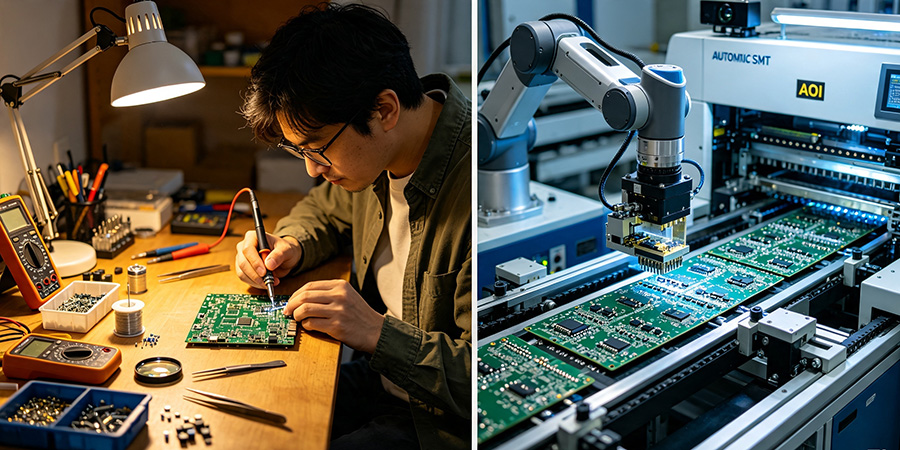
For small hobby projects, DIY PCB assembly may seem cost-effective, but industrial applications demand the precision and reliability that only professional PCB assembly capability can deliver. Below is a detailed comparison of DIY vs. professional PCB assembly, highlighting why industrial projects should prioritize professional services.
Precision & Consistency
DIY PCB assembly relies on manual soldering, which is prone to human error such as cold solder joints, component misalignment, and short circuits. Even experienced hobbyists struggle to achieve the ±0.02mm precision required for industrial components like BGAs. Professional PCB assembly capability uses automated SMT machines that place components with consistent accuracy, reducing defect rates by 90% compared to DIY builds. A study by the IPC found that professional assembly has a first-pass yield of 99.5%, while DIY assembly averages just 85% for complex PCBs.
Complex Component Handling
Industrial PCBs often include small, delicate components like 0201 resistors and fine-pitch BGAs, which are nearly impossible to solder manually without damaging them. Professional PCB assembly capability includes specialized equipment like pick-and-place machines with vacuum nozzles that handle these components gently. For example, a professional supplier can assemble a PCB with 1,000+ components in 10 minutes, while a DIY builder would take 8+ hours with a high risk of component damage.
Quality Control & Compliance
DIY PCB assembly lacks the quality control processes required for industrial applications. Professional PCB assembly capability includes AOI, X-ray inspection, and functional testing to detect defects before shipment. Suppliers also adhere to industry standards like IPC-A-610, ensuring PCBs meet reliability requirements for automotive and medical devices. A medical device manufacturer reported that switching from DIY to professional PCB assembly reduced field failures by 40%, ensuring compliance with FDA regulations.
Scalability & Lead Times
DIY assembly is limited to small batches, making it unsuitable for high-volume industrial projects. Professional PCB assembly capability includes automated lines that produce 10,000+ PCBs per day, with lead times as short as 7 days for mass production. For example, a consumer electronics company scaled production from 100 to 10,000 units per month by partnering with a professional PCB assembly supplier, meeting their market demand without compromising quality.
Cost-Effectiveness in the Long Run
While DIY PCB assembly may seem cheaper upfront, the cost of reworks, component damage, and product failures often exceeds the savings. Professional PCB assembly capability reduces long-term costs by minimizing defects and ensuring product reliability. An industrial automation company found that DIY assembly cost them $$20 per PCB in reworks, while professional assembly cost just$$2 per PCB, resulting in 90% cost savings over one year.
Thermal Management & Durability
Industrial PCBs require thermal management solutions like heat sink attachment and high-temperature solder, which are difficult to implement with DIY tools. Professional PCB assembly capability includes expertise in thermal design and assembly, ensuring PCBs operate reliably in harsh environments. A motor control manufacturer reported that professional assembly improved heat dissipation by 35%, extending PCB lifespan by 50% compared to DIY builds.
Conclusion: For industrial projects, professional PCB assembly capability outperforms DIY builds in precision, reliability, scalability, and cost-effectiveness. By partnering with a professional supplier, you can ensure your products meet industry standards, reduce defects, and deliver consistent results to your customers.
