
 Electronics Design & Development
 PCB Design & Layout Services
 PCB Fabrication & Prototyping
 PCB Assembly & PCBA Services





Box Build Assembly and Testing Services for Complex Electronics
Scaling OEM Hardware Production Through Integrated Box Build Assembly and Testing Services
Transitioning a hardware design from a functional printed circuit board assembly (PCBA) to a market-ready electronic device involves complex electro-mechanical integration. Managing separate vendors for PCB fabrication, enclosure machining, custom cable harnesses, and final product enclosure integration introduces severe supply chain vulnerabilities.
Single-source box build assembly and testing services eliminate multi-vendor friction by consolidating sub-system fabrication, mechanical enclosure integration, final wiring, firmware programming, and automated functional testing under one quality management system.
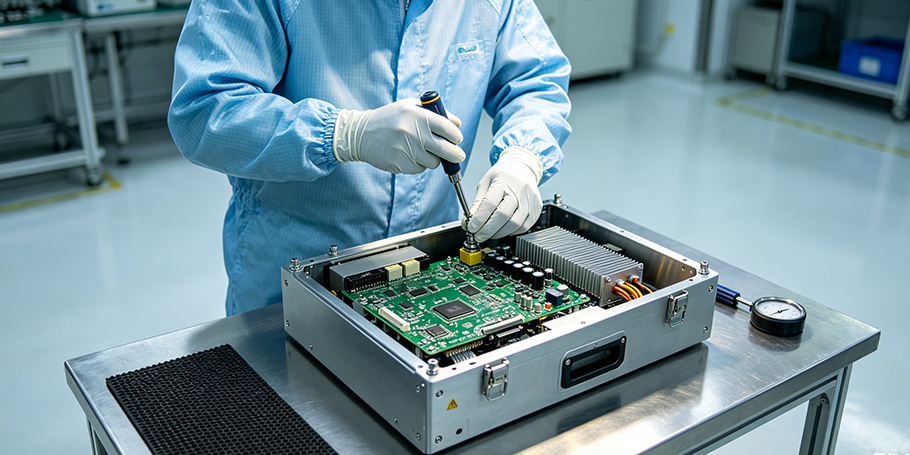
Engineering Challenges in Electro-Mechanical Box Build Integration
Final system integration extends beyond dropping a PCBA into a plastic or metal housing. High-reliability applications in medical devices, power electronics, and industrial controls demand rigorous control over mechanical tolerances and electrical interconnects.
1. Wire Harness Dynamics and Strain Relief Mechanics
Cabling failures represent over 35% of post-assembly field returns in box build projects. Integrating custom wire harnesses requires strict adherence to IPC-A-620 Class 2 and Class 3 standards for crimp pull-force metrics and terminal retention. Proper strain relief routing prevents vibration-induced fatigue on internal headers, especially in mobile industrial systems.
2. Thermal Management and Structural Enclosure Dissipation
High-power PCB assemblies generate localized heat spikes that alter component lifespan. During box build integration, applying precise thermal interface materials (TIM)—such as liquid gap fillers or pre-cut silicone thermal pads—with controlled compression ratios ensures efficient heat transfer from high-power MOSFETs to the external chassis. Maintaining a consistent thermal interface under 0.25mm bond line thickness prevents thermal throttling in sealed IP67-rated enclosures.
Advanced Testing Protocols for Zero-Defect System Delivery
A comprehensive manufacturing pipeline relies on layered end-of-line (EOL) testing strategies to catch sub-system defects before final packaging and shipping.
Automated Functional Circuit Testing (FCT): Unlike standard board-level testing, system-level FCT validates real-world operational environments. Custom test fixtures simulate field inputs, verifying analog signal processing, communication bus protocols (CAN bus, RS-485, Ethernet), and power supply regulation under full dynamic load conditions.
Environmental Stress Screening (ESS) and Burn-In: Subjecting fully assembled box build units to thermal cycling (ranging from -40°C to +85°C) inside environmental chambers accelerates infant mortality failures in passive components and semiconductor junctions. Operating units under full electrical stress for 12 to 48 hours guarantees early failure detection at the factory level rather than in the field.
High-Potential (Hi-Pot) Electrical Safety Testing: High-voltage industrial and medical systems undergo mandatory dielectric withstand testing. Verification ensures internal clearance and creepage distances prevent arc-over up to 4000V DC between primary power lines and chassis ground.
Supply Chain Advantages of Single-Source System Integration
Partnering with an experienced contract manufacturer for complete box build solutions yields measurable operational efficiency across the entire product lifecycle.
Lower Total Cost of Ownership: Consolidating component sourcing, mechanical assembly, and functional testing under a single roof eliminates redundant freight expenses, reduces buffer inventory requirements, and drops incoming inspection costs by up to 22%.
Accelerated Time-to-Market for New Product Introduction (NPI): Concurrent DFM (Design for Manufacturability) and DFA (Design for Assembly) reviews during early prototype stages reduce mechanical interference risks. Optimizing fastener counts, standardized harness routings, and modular sub-assemblies cuts final assembly dwell times by 30%.
Unified Quality Traceability: Complete serial-number tracking links every component batch, PCBA firmware revision, torque validation metric, and automated functional test report. This level of data integration ensures full compliance with ISO 9001, ISO 13485, and UL factory audit standards.
Partner with a Turnkey Box Build Assembly Specialist
Achieving consistent first-pass yield in complex electro-mechanical manufacturing requires advanced assembly automation, rigorous IPC quality standards, and deep technical expertise.
Ready to streamline your OEM product manufacturing?
Submit your 3D CAD models, Gerber files, and functional testing specifications to our engineering team today for a comprehensive DFA assessment and turnkey production estimate!
