
 Electronics Design & Development
 PCB Design & Layout Services
 PCB Fabrication & Prototyping
 PCB Assembly & PCBA Services





A Buyer Guide to PCB Wave Soldering Capabilities and Total Cost Optimization for Thru Hole Assemblies
In an era dominated by micro-SMD components and ultra-fine pitch BGAs, Through-Hole Technology (THT) remains indispensable for power electronics, industrial control boards, automotive modules, and medical control boards. Connectors subjected to high mechanical insertion forces or inductors carrying high currents demand the superior mechanical shear strength and thermal handling of through-hole joints.
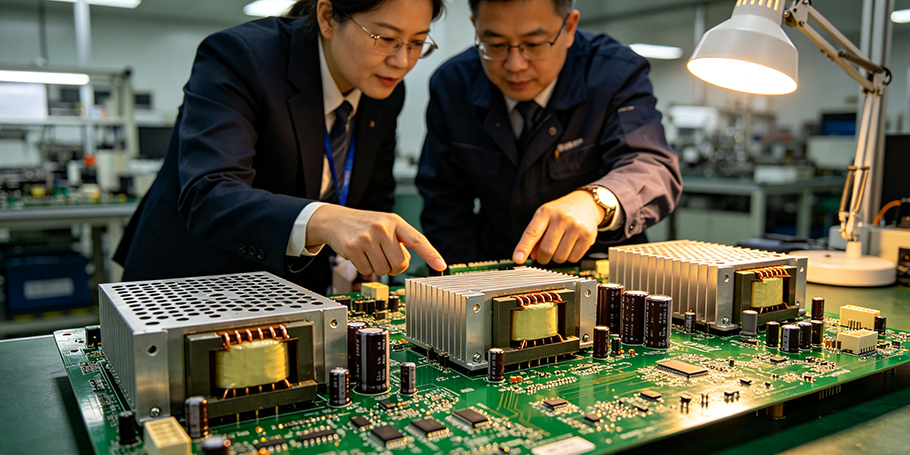
For hardware procurement managers and sourcing leads, evaluating vendor capabilities for pcb wave soldering for thru hole components is critical. A supplier lacking tight process controls can introduce hidden assembly defects, resulting in costly manual rework, delayed shipment schedules, and premature field failures.
Balancing Component Unit Costs and Assembly Complexity
Sourcing mixed-technology circuit boards requires understanding how THT assembly impacts the Total Cost of Ownership (TCO). While through-hole components often have lower raw component costs than specialized high-current SMT equivalents, their assembly involves extra labor and specialized tooling.
1. Automated Insertion vs. Manual Kitting Costs
High-volume THT production relies on automated axial and radial insertion machines to place resistors, diodes, and capacitors onto boards at speeds exceeding 10,000 components per hour. However, odd-form components like heavy transformers or multi-pin headers require manual placement. Buyers should evaluate whether a vendor uses ergonomic lead-forming jigs and Poka-Yoke insertion tables to minimize human assembly errors.
2. Wave Solder Pallet (Tooling) Capital Expenditure
When bottom-side SMT components are present on a mixed board, passing the assembly over an open wave pot will wash away surface-mount passives. To protect these components, fabricators build custom composite wave solder pallets (titanium or synthetic resin masks). Sourcing teams must factor this one-time NPI tooling cost into early financial models.
Key Technical Audits for Wave Soldering Vendor Selection
To protect your brand against field failures, procurement managers should evaluate potential manufacturing partners against four stringent technical metrics:
Nitrogen Atmosphere Integration: Verify whether the vendor uses nitrogen-purged (N2) wave soldering ovens. Nitrogen purging reduces tin dross formation by over 80%, improves solder surface tension, and ensures 99.5%+ first-pass yield on lead-free SAC305 processing.
Flux Chemistry and Specific Gravity Control: Improper flux density leads to unreacted residue or weak soldering wetting. Advanced vendors utilize closed-loop, automated specific gravity monitoring systems to maintain precise flux-to-solvent ratios throughout high-volume runs.
Inspection Capabilities for Hidden PTH Joints: Standard visual inspection cannot accurately verify 75% to 100% vertical barrel solder fill under thick connector bodies. Ensure your supplier operates 3D Automated Optical Inspection (AOI) and 3D Automated X-Ray Inspection (AXI) systems to quantify barrel fill depth non-destructively.
Operational Metrics: Evaluating Factory Quality Deliverables
A high-capability PCBA contract manufacturer should demonstrate consistent operational control metrics across all through-hole assembly runs:
First-Pass Yield (FPY) Standards: World-class THT assembly lines achieve first-pass yields exceeding 99.2% through wave soldering, reducing post-wave manual iron touch-up to under 0.8%.
Solder Pot Purity Testing: Lead-free solder pots accumulate copper contamination over time as copper traces dissolve into the wave. Quality vendors perform monthly ICP-OES elemental analysis on their solder pots to keep copper content strictly below 1.0% by weight, preventing brittle intermetallic solder joints.
Full IPC Class 3 Traceability: Ensure the factory provides complete lot traceability linking raw PCB laminate lot numbers, flux batch codes, and wave pot temperature logs to individual serial numbers via laser-etched barcodes.
Secure Your Through-Hole Assembly Supply Chain Today
Do not allow poor wave soldering parameters, insufficient barrel fill, or lack of process control to compromise your product reliability and launch timelines.
Ready to streamline your next mixed SMT/THT hardware build?
Contact our technical engineering team today to upload your Gerber files and BOM for a free, comprehensive DFM review, stackup check, and instant turnkey manufacturing quote!
