
 Electronics Design & Development
 PCB Design & Layout Services
 PCB Fabrication & Prototyping
 PCB Assembly & PCBA Services





The Ultimate Guide to Printed Circuit Assembly (PCA) Process: From Design to Delivery
Printed Circuit Assembly (PCA) is the backbone of modern electronics, transforming bare printed wiring boards (PWBs) into functional circuit boards. Whether you’re prototyping a new device or scaling production, understanding the PCA process is critical for ensuring product quality and reliability. Below is a step-by-step breakdown of the complete printed circuit assembly workflow:
1. Design for Manufacturability (DFM) Validation
Before production begins, your printed circuit assembly partner will conduct a DFM review to optimize your design for assembly. This involves checking for component spacing, pad sizes, trace widths, and solder mask alignment to avoid costly errors. A thorough DFM review ensures your design is production-ready and reduces the risk of defects during assembly.
2. Component Sourcing & Inventory Management
A reliable printed circuit assembly service will source high-quality components from authorized distributors to avoid counterfeit parts. They’ll verify component specifications, check for availability, and manage inventory to ensure timely production. For obsolete components, they can provide alternative solutions to keep your project on track.
3. Printed Wiring Board (PWB) Preparation
The bare printed wiring board is cleaned and inspected to ensure it meets quality standards. This includes checking for defects like scratches, copper traces damage, or incorrect plating. The PWB is then prepared for component placement, with solder paste applied using a stencil for precise alignment.
4. Surface Mount Technology (SMT) Component Placement
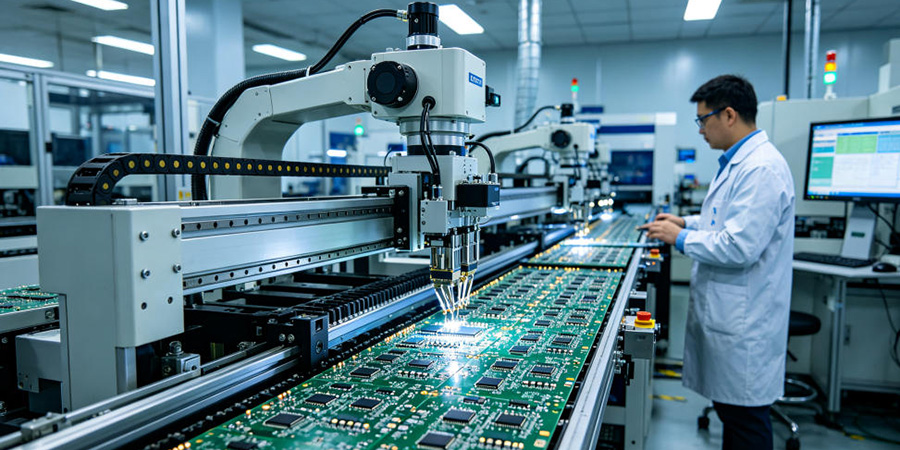
Most modern printed circuit assembly projects use SMT for component placement. Automated pick-and-place machines use vacuum nozzles to place tiny SMT components directly onto the PWB surface. These machines can place thousands of components per hour with micron-level accuracy, ensuring consistent quality.
5. Reflow Soldering
After component placement, the PWB is passed through a reflow oven, where the solder paste melts and forms permanent bonds between components and pads. The oven’s temperature profile is carefully controlled to prevent component damage and ensure proper solder wetting. Lead-free reflow processes comply with RoHS regulations for environmentally friendly production.
6. Through-Hole Technology (THT) Assembly (If Required)
For larger components like connectors or power transistors, through-hole assembly may be used. Components are inserted into pre-drilled holes in the PWB, and soldered using wave soldering or manual soldering. THT provides stronger mechanical connections for components subject to stress or vibration.
7. Inspection & Testing
Rigorous inspection and testing are critical for printed circuit assembly quality control:
Automated Optical Inspection (AOI): Cameras detect soldering defects, missing components, or misaligned parts.
In-Circuit Testing (ICT): Tests individual components and connections to ensure functionality.
Functional Testing: Validates the PCB’s performance under real-world conditions.
X-Ray Inspection: For hidden solder joints like BGAs, X-ray technology checks for voids or poor connections.
8. Post-Assembly Processes
Additional services may include conformal coating to protect against moisture and dust, labeling, or packaging. The printed circuit boards are then cleaned to remove flux residues and ensure compliance with industry standards.
9. Final Delivery
After passing all quality checks, the finished printed circuit assemblies are packaged securely and delivered according to your timeline. A professional printed circuit assembly service will provide tracking information and support to ensure your project reaches you on time.
Conclusion: By understanding the printed circuit assembly process, you can collaborate more effectively with your service provider and ensure your project meets quality and timeline expectations. Partnering with an experienced PCA provider will help you navigate each step and deliver reliable, high-quality PCBs for your electronics.
