
 Electronics Design & Development
 PCB Design & Layout Services
 PCB Fabrication & Prototyping
 PCB Assembly & PCBA Services





Key Task Hardware: Evaluating turnkey PCB assembly services in the medical electronics industry
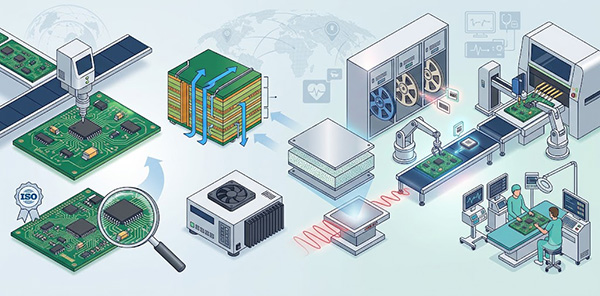
Electronic devices used in the medical industry, such as CT scanner imaging arrays, patient monitoring systems, and diagnostic control units, require extremely high reliability and tolerate no faults whatsoever. A single defect on the imaging array or control board may jeopardize patient safety and diagnostic accuracy.
For original equipment manufacturers (OEMs)in this industry, collaborating with suppliers capable of providing certified turnkey PCB assembly services is a strategic necessity to ensure stringent quality control, trace component sources, and maintain strict compliance.
Addressing regulatory compliance and certification requirements
Medical electronic products are subject to stringent international quality frameworks. Qualified turnkey assembly service providers must establish a certified manufacturing ecosystem, which encompasses the following aspects:
ISO 13485: The gold standard for medical device quality management systems.
IPC-A-610 Level 3: The highest standard for electronic components, with stringent requirements for soldering quality, component spacing, and structural robustness to ensure uninterrupted operation in life-critical or mission-critical monitoring applications.
Through a one-stop workflow, compliance documents—including material certificates, component batch tracking records, and reflow soldering curve data—are consolidated under a single tracking number, thereby streamlining the audit process.
Material Selection and Structural Engineering for Medical Devices
Medical control units (e.g., high-speed CT scanners) require a complex multi-layer architecture to handle high data throughput without being susceptible to electromagnetic interference (EMI).
These circuit boards typically employ FR-4 substrates with high Tg (glass transition temperature) or specialized composite materials to withstand continuous thermal cycling within the enclosed scanner gantry.
Furthermore, advanced imaging arrays typically employ a lightweight sandwich structure and utilize PMI foam material. Due to its extremely low dielectric constant (Dk ≈ 1.05), PMI foam exhibits a low loss tangent, making it an ideal structural core for medical radar domes and X-ray platforms. This design maximizes structural stiffness while ensuring optimal wave transmission efficiency and minimal signal attenuation.
Comprehensive component traceability and verification
Counterfeit or substandard components pose a significant threat to medical hardware. Our turnkey partners procure components directly from authorized factory channels, ensuring the security of your supply chain. Component-level traceability guarantees that every capacitor, microcontroller, and operational amplifier on the PCBA can be traced back to its specific production batch number and date code.
Moreover, a true turnkey solution goes far beyond a reflow soldering furnace. It encompasses a comprehensive testing strategy that includes online testing (ICT), flying pin testing for prototype verification, and customized functional testing (FCT) simulating real-world medical operating environments. This ensures that every circuit board leaving the factory operates flawlessly in practical applications.
