
 Electronics Design & Development
 PCB Design & Layout Services
 PCB Fabrication & Prototyping
 PCB Assembly & PCBA Services





PCB Fabrication vs. Assembly: What's the Difference and How to Choose the Right Manufacturer
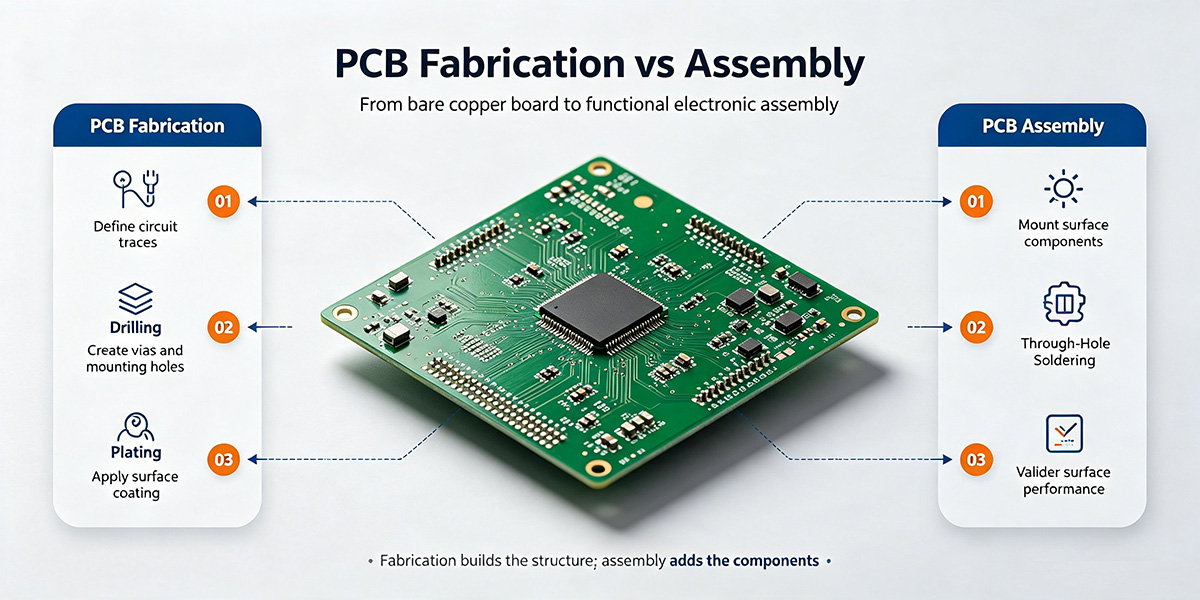
Many electronics designers and manufacturers use the terms "PCB fabrication" and "PCB assembly" interchangeably, but they are two distinct processes. Understanding the difference is critical for choosing the right PCB board manufacturer for your project. Below is a detailed comparison of PCB fabrication and assembly, and guidance on how to select the right manufacturer.
What is PCB Fabrication?
PCB fabrication is the process of manufacturing bare printed circuit boards from raw materials. Key steps include:
Design File Preparation: Converting Gerber files into manufacturing instructions
Material Cutting: Cutting copper-clad substrates to the required size
Drilling: Creating holes for vias and component leads
Plating: Coating holes with copper to create electrical connections between layers
Etching: Removing excess copper to form circuit traces
Solder Mask Application: Applying a protective layer to the PCB
Silkscreen Printing: Adding component labels and logos
Finish Application: Applying a surface finish to protect copper traces and improve solderability A PCB fabrication manufacturer specializes in producing bare PCBs, while some also offer assembly services as an add-on.
What is PCB Assembly?
PCB assembly (also known as PCBA) is the process of soldering electronic components onto a bare PCB. Key steps include:
Component Preparation: Sourcing and inspecting electronic components
SMT Placement: Using automated pick-and-place machines to place surface-mount components
Reflow Soldering: Heating the PCB to melt solder and attach components
Through-Hole Assembly: Inserting and soldering through-hole components (if required)
Inspection: Using automated optical inspection (AOI) and X-ray inspection to detect defects
Testing: Conducting functional testing to ensure the assembled PCB works correctly A PCB board manufacturer may offer assembly services, or you may need to work with a separate assembly provider.
Key Differences Between Fabrication and Assembly
Factor | PCB Fabrication | PCB Assembly |
Output | Bare PCB | Assembled PCB (PCBA) |
Equipment | Drilling machines, etching tanks, plating lines | Pick-and-place machines, reflow ovens, AOI systems |
Skill Requirements | PCB manufacturing expertise | Component sourcing, soldering, testing expertise |
Lead Times | 24-72 hours for prototypes, 5-10 days for production | 3-5 days for prototypes, 7-14 days for production |
Cost Drivers | Material costs, layer count, feature sizes | Component costs, assembly complexity, testing requirements |
How to Choose the Right Manufacturer
When choosing a PCB manufacturer, consider whether you need fabrication only, assembly only, or turnkey services (both fabrication and assembly). Key factors include:
Project Complexity: For simple projects, a manufacturer that offers both services may be more convenient. For complex projects, you may benefit from working with specialized fabrication and assembly providers.
Component Sourcing: If you need help sourcing components, look for a manufacturer with strong supply chain capabilities.
Quality Control: Ensure the manufacturer has robust quality control processes for both fabrication and assembly.
Cost: Compare quotes from manufacturers offering turnkey services vs. separate fabrication and assembly providers. A Chinese consumer electronics company reduced logistics costs by 25% by using a turnkey PCB manufacturer that handled both fabrication and assembly in a single facility.
Case Study: Turnkey vs. Separate Services for a Medical Device
A European medical device company was evaluating whether to use a turnkey PCB manufacturer or separate fabrication and assembly providers. They found:
Turnkey Services: 15% higher total cost, but 30% faster lead times due to integrated processes
Separate Services: Lower cost, but required additional coordination between two providers, leading to 20% longer lead times The company ultimately chose turnkey services to meet their tight product launch deadline.
Conclusion
PCB fabrication and assembly are distinct processes that require different expertise and equipment. When choosing a PCB board manufacturer, consider your project requirements, complexity, and timeline to decide whether to work with a specialized fabrication provider, assembly provider, or turnkey manufacturer. By understanding the differences between these services, you can make an informed decision that will help you bring your product to market efficiently and cost-effectively.
