
 Electronics Design & Development
 PCB Design & Layout Services
 PCB Fabrication & Prototyping
 PCB Assembly & PCBA Services





5 Ways Turnkey PCB Assembly Transforms Automotive Electronics Manufacturing
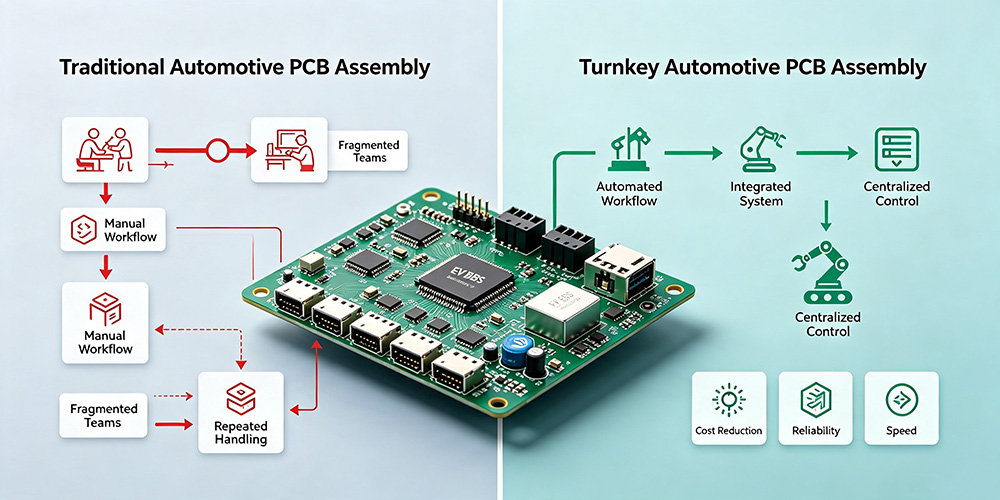
Automotive electronics is undergoing a revolution driven by electric vehicles (EVs) and advanced driver-assistance systems (ADAS). These technologies demand high-performance, reliable PCBs that can withstand extreme temperatures, vibration, and electrical loads. Traditional PCB assembly models struggle to meet these requirements due to fragmented supply chains, limited automotive-grade component access, and complex quality control needs. Turnkey PCB assembly offers a solution by integrating design, manufacturing, and testing under one vendor, transforming how automotive electronics are produced. Below are 5 ways turnkey PCB assembly is revolutionizing automotive electronics manufacturing.
1. Automotive-Grade Component Sourcing & Traceability
EVs and ADAS systems require components that meet strict automotive standards (AEC-Q100, IATF 16949) for reliability and durability. Traditional assembly models often rely on generic components that don’t meet these standards, leading to field failures and safety risks. Turnkey PCB assembly vendors specialize in sourcing automotive-grade components with full traceability, ensuring that every part meets industry requirements. A US-based EV startup found that using turnkey assembly reduced component-related field failures by 40% by eliminating non-automotive-grade parts from their supply chain.
2. Integrated DFM for Automotive Environments
Automotive PCBs operate in harsh environments with extreme temperatures (-40°C to 125°C), vibration, and electrical noise. Traditional DFM analysis often overlooks these environmental factors, leading to design failures. Turnkey vendors provide specialized DFM analysis for automotive applications, including thermal management, vibration resistance, and electromagnetic compatibility (EMC) testing. A German automotive supplier reduced design iterations by 60% by using turnkey assembly’s automotive-specific DFM services, ensuring that their ADAS sensor PCBs met all environmental requirements from the start.
3. High-Voltage PCB Assembly Expertise
EVs require high-voltage PCBs (up to 800V) for battery management systems (BMS) and powertrain components. These PCBs require specialized assembly techniques, including thick copper traces (10oz+), isolation barriers, and high-voltage testing. Traditional assembly vendors often lack expertise in high-voltage PCB assembly, leading to safety hazards and performance issues. Turnkey vendors have dedicated high-voltage assembly lines with trained technicians and specialized testing equipment. A Chinese EV manufacturer reduced high-voltage PCB assembly defects by 75% by partnering with a turnkey vendor with high-voltage expertise.
4. IATF 16949 Compliant Quality Control
Automotive electronics manufacturers must comply with IATF 16949 quality management standards, which require strict traceability, process control, and continuous improvement. Traditional assembly models often struggle to meet these requirements due to fragmented processes and limited quality control resources. Turnkey vendors are IATF 16949 certified and implement automated quality control processes, including X-ray inspection, functional testing, and statistical process control (SPC). A Japanese automotive electronics supplier reduced audit non-conformances by 90% by switching to a turnkey vendor with IATF 16949 certification.
5. Accelerated Time-to-Market for Automotive Innovations
EV and ADAS technologies are evolving rapidly, requiring manufacturers to launch new products quickly to stay competitive. Traditional assembly models lead to delays due to supply chain bottlenecks, design rework, and quality control issues. Turnkey assembly accelerates time-to-market by integrating design, manufacturing, and testing, reducing project lead times by 30–40%. A US-based ADAS startup reduced their product launch time from 16 weeks to 10 weeks by using turnkey assembly, allowing them to launch their sensor system 6 weeks ahead of competitors.
Case Study: Turnkey PCB Assembly Powers EV BMS Innovation
A European EV startup was struggling to develop a reliable battery management system (BMS) due to challenges in high-voltage PCB assembly and automotive-grade component sourcing. They partnered with a turnkey PCB assembly vendor and achieved the following results:
BMS Reliability Improved by 35%: Automotive-grade components and specialized DFM analysis reduced field failure rates from 5% to 3.25%.
Production Costs Reduced by 20%: Bulk component sourcing and integrated quality control eliminated hidden costs associated with fragmented assembly.
Time-to-Market Accelerated by 30%: Integrated design and manufacturing reduced project lead times from 12 weeks to 8 weeks.
Conclusion
Turnkey PCB assembly is transforming automotive electronics manufacturing by addressing the unique challenges of EVs and ADAS systems. From automotive-grade component sourcing to high-voltage assembly expertise, turnkey vendors provide the specialized capabilities needed to produce reliable, high-performance PCBs for automotive applications. For automotive electronics manufacturers looking to improve product reliability, reduce costs, and accelerate time-to-market, turnkey PCB assembly is the clear choice. When selecting a turnkey vendor, look for a partner with IATF 16949 certification, high-voltage assembly expertise, and a proven track record in automotive electronics.
