
 Electronics Design & Development
 PCB Design & Layout Services
 PCB Fabrication & Prototyping
 PCB Assembly & PCBA Services





PCB Board Manufacturer vs. PCB Board Maker: What’s the Difference?
When searching for PCB manufacturing services, you’ll often come across the terms "PCB board manufacturer" and "PCB board maker." While these terms are sometimes used interchangeably, there are key differences between the two. Understanding these differences can help you choose the right supplier for your project, whether you need industrial PCB manufacturing or small-scale prototype production. Below is a breakdown of the differences between a PCB board manufacturer and a PCB board maker.
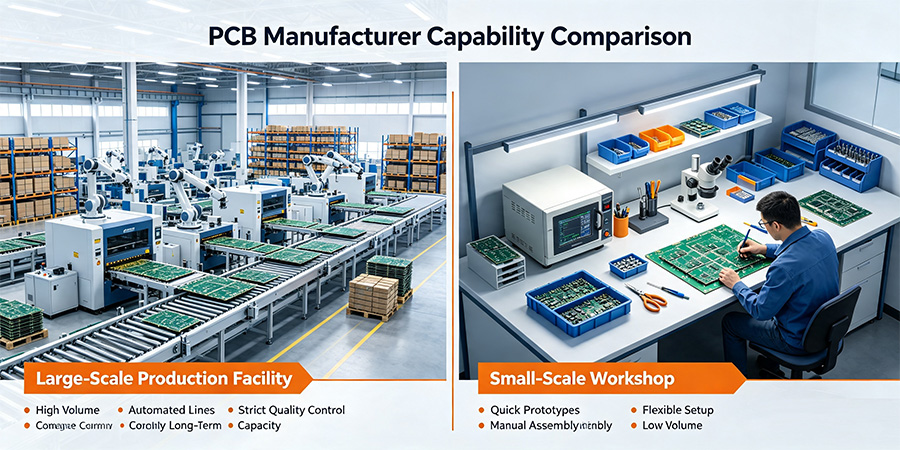
1. Production Capacity & Scale
PCB board manufacturer: Large-scale facilities with automated production lines, capable of producing thousands to millions of PCBs per month. They specialize in mass production for industrial, automotive, and consumer electronics projects.
PCB board maker: Small-scale workshops or local suppliers that focus on prototype production and small-batch orders (1–100 PCBs). They are ideal for hobbyists, startups, and small businesses with low-volume needs.
2. Manufacturing Capabilities
PCB board manufacturer: Offer advanced manufacturing capabilities for complex PCB designs, including multi-layer boards (up to 48 layers), high-precision routing, and specialized materials like aluminum and Rogers. They also provide in-house SMT assembly, component sourcing, and turnkey solutions.
PCB board maker: Typically offer basic PCB manufacturing services, including single-layer and double-layer boards with standard materials like FR-4. They may outsource assembly and component sourcing to third-party suppliers.
3. Quality Control & Certifications
PCB board manufacturer: Have strict quality control processes and industry certifications like ISO 9001, IPC-A-610, and ISO 13485. They use advanced testing equipment like AOI and X-ray inspection to ensure high-quality PCBs.
PCB board maker: May have basic quality control processes but often lack industry certifications. They rely on manual inspection, which can lead to higher defect rates.
4. Lead Times & Turnaround
PCB board manufacturer: Offer fast turnaround times for both prototypes and mass production. Prototypes can be delivered in 24–48 hours, and mass production orders are completed in 7–14 days due to automated processes and large production capacity.
PCB board maker: May have longer lead times for prototypes (3–7 days) due to manual production processes. They may struggle to meet tight deadlines for large orders.
5. Pricing & Cost
PCB board manufacturer: Offer competitive pricing for mass production orders due to economies of scale. They may charge higher prices for prototypes but provide discounts for repeat orders.
PCB board maker: Charge lower prices for small-batch orders and prototypes but may not offer discounts for large volumes. Their overall costs can be higher for mass production due to manual processes.
Which One Should You Choose?
Choose a PCB board manufacturer if you need industrial PCB manufacturing, mass production, complex designs, or strict quality control. They are ideal for large businesses, automotive, and medical device projects.
Choose a PCB board maker if you need small-scale prototypes, low-volume orders, or local support. They are perfect for hobbyists, startups, and small businesses with limited budgets.
Conclusion: Whether you choose a PCB board manufacturer or a PCB board maker depends on your project’s size, complexity, and quality requirements. For industrial PCB manufacturing and large-scale production, a PCB board manufacturer is the best choice. For small-scale prototypes and low-volume orders, a PCB board maker may be more cost-effective.
