
 Electronics Design & Development
 PCB Design & Layout Services
 PCB Fabrication & Prototyping
 PCB Assembly & PCBA Services





The Future of PCB Board Manufacturing: Automation & AI
PCB board manufacturing is undergoing a major transformation with the adoption of automation and artificial intelligence (AI). These technologies are improving efficiency, quality, and speed, making it easier for PCB board manufacturers to meet the growing demand for industrial PCB manufacturing and complex designs. Below are the key ways automation and AI are shaping the future of PCB board manufacturing.
1. Automated Production Lines for Faster Manufacturing
PCB board manufacturers are investing in fully automated production lines to reduce lead times and increase output. These lines use robotic arms, conveyor belts, and advanced machinery to handle every stage of PCB manufacturing, from material loading to final assembly. Automated production lines can produce PCBs 24/7, reducing lead times for mass production orders by up to 50%. For example, a leading PCB board manufacturer in China uses automated lines to produce 1 million PCBs per month, with a 99.9% pass rate.
2. AI-Powered Quality Control
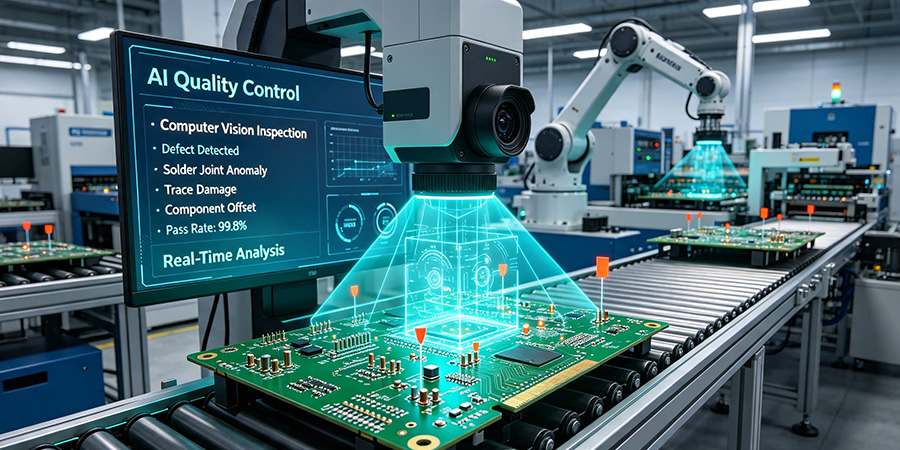
AI is revolutionizing quality control in PCB board manufacturing. AI-powered systems use computer vision and machine learning to detect defects like soldering errors, missing components, and incorrect component placement with 99% accuracy. These systems can inspect thousands of PCBs per hour, reducing the need for manual inspection and improving quality. For instance, a PCB board manufacturer in the US reported that AI-powered quality control reduced defect rates by 30% and saved $1 million per year in rework costs.
3. AI-Assisted PCB Design
AI is also transforming PCB design, making it faster and more efficient. AI-powered design tools use machine learning to generate optimized PCB layouts in minutes, considering factors like signal integrity, thermal management, and manufacturability. These tools can also predict design issues before production, reducing the need for costly reworks. For example, an AI design tool developed by a PCB board manufacturer reduced layout time for complex industrial PCBs by 70% compared to manual design.
4. Predictive Maintenance for Equipment
PCB board manufacturers use AI to monitor production equipment and predict maintenance needs. Sensors collect data on machine performance, and AI algorithms analyze this data to detect potential failures before they occur. Predictive maintenance reduces unplanned downtime by up to 40%, ensuring continuous production and reducing costs. A PCB board manufacturer in Japan reported that predictive maintenance saved $500,000 per year in equipment repair costs.
5. Smart Supply Chain Management
AI is improving supply chain management for PCB board manufacturers. AI algorithms analyze global supply chain data to predict component shortages, price fluctuations, and delivery delays. This allows manufacturers to proactively source components, adjust production schedules, and reduce supply chain risks. For example, a PCB board manufacturer in Germany uses AI to optimize component sourcing, reducing lead times by 20% and lowering costs by 15%.
Conclusion: Automation and AI are transforming PCB board manufacturing, making it faster, more efficient, and more reliable. For industrial PCB manufacturing and complex designs, these technologies are essential for meeting the growing demand for high-quality, fast-delivered PCBs. As PCB board manufacturers continue to adopt automation and AI, the future of PCB manufacturing looks brighter than ever.
