
 Electronics Design & Development
 PCB Design & Layout Services
 PCB Fabrication & Prototyping
 PCB Assembly & PCBA Services





PCB Prototyping Mistakes to Avoid: Save Time & Money on Your Next Project
PCB prototyping is a complex process, and even small mistakes can lead to costly delays and reworks. For engineers and designers, avoiding common PCB prototyping mistakes is critical for ensuring your PCB board prototype is successful. Below are the top mistakes to avoid when creating a prototype printed circuit board.
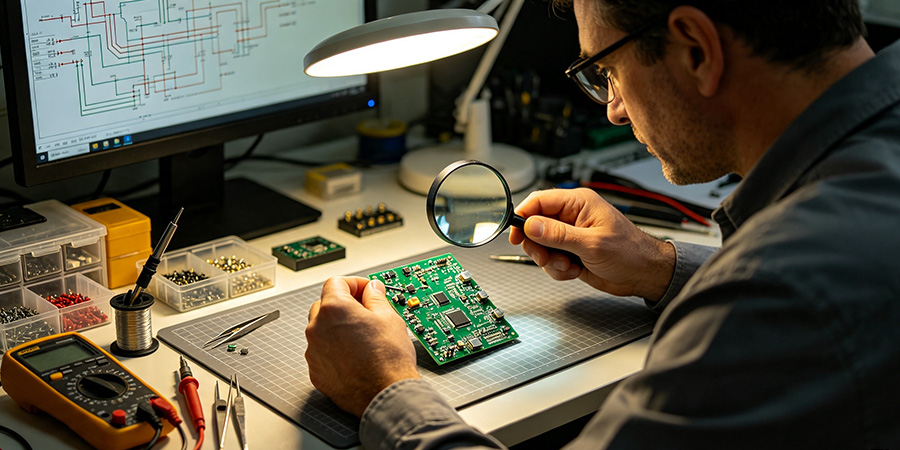
Mistake 1: Ignoring Design for Manufacturability (DFM)
One of the most common PCB prototyping mistakes is ignoring DFM guidelines. Designs that are difficult to produce can increase costs, lead to delays, and result in a faulty prototype printed circuit board. To avoid this, work with your PCB prototyping service to get a free DFM check before production. They can identify issues like tight trace spacing, small hole sizes, or complex layouts that can be simplified.
Mistake 2: Choosing the Wrong PCB Material
Using the wrong PCB material can lead to performance issues and premature failure of your PCB board prototype. For example, using FR-4 for a high-power application that requires high heat dissipation can cause the board to overheat and fail. To avoid this, choose a material that matches your project’s requirements:
FR-4 for low-frequency, general-purpose projects.
Aluminum PCB for high-power applications that require heat dissipation.
Rogers material for high-frequency circuits that need excellent signal integrity.
Mistake 3: Poor Component Placement
Incorrect component placement can cause signal integrity issues, thermal management problems, and difficulty in assembly. To avoid this:
Place heat-generating components (e.g., power transistors) away from heat-sensitive components (e.g., sensors).
Keep high-speed signals away from low-speed signals to reduce crosstalk.
Place components with large footprints (e.g., connectors) along the edges of the board to make assembly easier.
Mistake 4: Skipping Prototype Testing
Skipping prototype testing is a costly mistake that can lead to mass production of faulty products. Always test your PCB board prototype thoroughly before moving to mass production. Use tools like multimeters, oscilloscopes, and logic analyzers to verify functionality, signal integrity, and power performance. If you find issues, debug the circuit and make improvements before ordering more prototypes.
Mistake 5: Not Considering Future Scalability
Designing a prototype printed circuit board that can’t be scaled to mass production can lead to costly reworks later. To avoid this, design your prototype with scalability in mind:
Use standard components that are readily available in large quantities.
Follow mass production DFM guidelines, even for your prototype.
Choose a PCB prototyping service that can handle both small-batch prototypes and large-volume production.
Conclusion: By avoiding these common PCB prototyping mistakes, you can save time, reduce costs, and ensure your PCB board prototype is successful. Whether you’re a beginner or an experienced engineer, taking the time to plan and test your prototype can help you create a high-quality product that meets your requirements.
