
 Electronics Design & Development
 PCB Design & Layout Services
 PCB Fabrication & Prototyping
 PCB Assembly & PCBA Services





Industrial PCB Manufacturing: Key Challenges & Solutions
Industrial PCB manufacturing presents unique challenges due to the harsh environments, high performance requirements, and strict quality standards of industrial applications. Top PCB board manufacturers use advanced technology and specialized processes to overcome these challenges and produce high-quality, reliable boards. Below are the key challenges in industrial PCB manufacturing and how leading PCB board makers solve them.
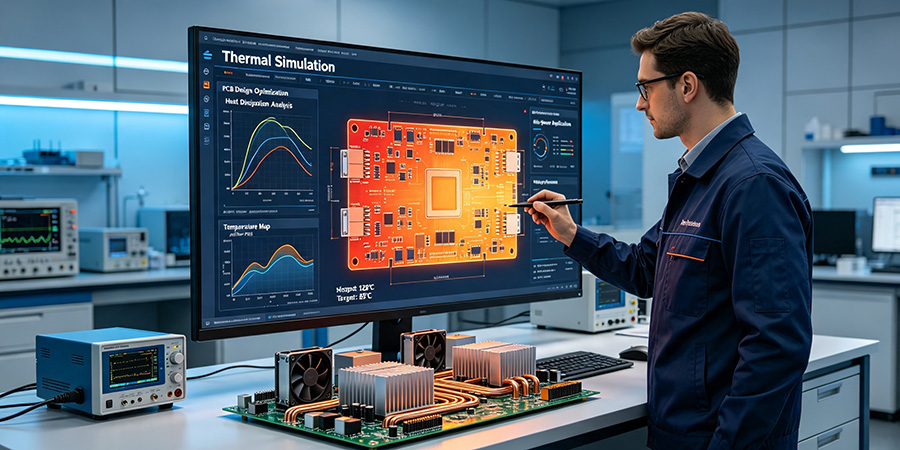
1. Heat Dissipation in High-Power Industrial PCBs
Industrial applications often generate high levels of heat, which can damage components and reduce the lifespan of PCBs. PCB board manufacturers solve this challenge by:
Using aluminum PCBs: Aluminum substrates offer excellent heat dissipation, making them ideal for high-power industrial applications like motor controls and power supplies.
Adding thermal vias: Thermal vias transfer heat from components to the aluminum substrate or heat sink, improving heat dissipation.
Using thermal simulation tools: Advanced software simulates heat distribution in PCB designs, allowing engineers to optimize component placement and trace routing for better heat management.
2. Ensuring Signal Integrity in High-Frequency Industrial PCBs
High-frequency industrial applications (e.g., 5G communication, radar systems) require PCBs with excellent signal integrity to prevent data corruption. PCB board manufacturers address this by:
Using Rogers materials: Rogers substrates offer low dielectric loss and stable electrical properties at high frequencies.
Implementing controlled impedance routing: Precise trace widths and spacing maintain consistent impedance, reducing signal reflections and crosstalk.
Adding ground planes: Ground planes shield high-frequency signals from electromagnetic interference (EMI) and provide a low-impedance return path.
3. Meeting Strict Quality & Compliance Standards
Industrial PCBs must comply with strict quality and regulatory standards to ensure safety and reliability. PCB board manufacturers ensure compliance by:
Implementing ISO 9001 quality management systems: Standardized processes ensure consistent quality across all production stages.
Conducting rigorous testing: Automated optical inspection (AOI), X-ray inspection, and functional testing detect defects before shipment.
Obtaining industry-specific certifications: ISO 13485 for medical devices, IATF 16949 for automotive electronics, and UL 94 for flammability resistance.
4. Managing Complex Supply Chains for Industrial Components
Industrial PCBs often require specialized components that can be difficult to source. PCB board manufacturers solve this by:
Maintaining large component inventories: Stocking common industrial components to avoid delays due to shortages.
Partnering with reliable suppliers: Long-term relationships with component suppliers ensure a steady supply of high-quality parts.
Offering component sourcing services: In-house teams source hard-to-find components, saving time and reducing supply chain risks.
5. Reducing Lead Times for Industrial PCB Orders
Industrial projects often have tight deadlines, so reducing lead times is critical. PCB board manufacturers achieve fast turnaround by:
Using automated production lines: Fully automated SMT assembly and PCB manufacturing lines reduce production time by up to 50%.
Operating 24/7 production facilities: Round-the-clock manufacturing ensures fast delivery of industrial PCB orders.
Offering express prototyping services: 24-hour turnaround for industrial PCB prototypes allows engineers to test designs quickly.
Conclusion: Industrial PCB manufacturing presents unique challenges, but top PCB board manufacturers use advanced technology, specialized processes, and rigorous quality control to overcome them. By partnering with a reputable PCB board manufacturer with expertise in industrial PCB manufacturing, you can ensure your project meets the highest standards of quality, reliability, and performance.
