
 Electronics Design & Development
 PCB Design & Layout Services
 PCB Fabrication & Prototyping
 PCB Assembly & PCBA Services





Supply Chain Resilience in Commercial PCB Manufacturing – Strategies to Avoid Delays
Even the most brilliantly designed PCB is worthless if it arrives three months late. In today’s volatile electronics market, supply chain disruptions are the norm – from copper foil shortages to MCU allocation crises. For commercial applications, where product launch dates are non-negotiable, mastering supply chain management is as critical as mastering circuit design. This article provides actionable strategies to safeguard your PCB design and manufacturing for commercial applications against delays, ensuring your production line stays humming and your customers stay satisfied.
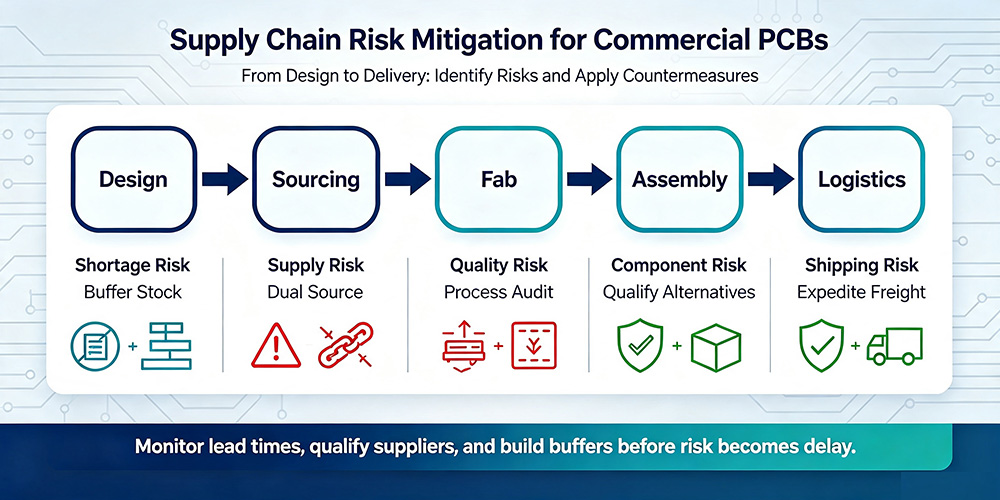
1. Early Supplier Engagement and Design-for-Sourcing
The most effective delay prevention starts before the first schematic netlist. Involve your PCB fab and component distributors during the design phase. They can alert you to long-lead parts or materials that are entering allocation. For commercial products, consider using “preferred parts” lists – components that are widely available from multiple manufacturers (e.g., generic 0402 resistors, standard logic ICs). Avoid custom or proprietary passives that have limited second sources. Also, design with alternate footprint compatibility; for example, using a 0.5mm pitch BGA that can accommodate an alternate pinout from a different vendor. This design-for-sourcing approach reduces dependency on a single supplier and gives you negotiating power when shortages hit.
2. Buffer Stock and Kanban Systems
Commercial manufacturing often operates on just-in-time (JIT) principles, but JIT is fragile in a crisis. The solution: strategic buffer stock – maintain a safety stock of critical bare PCBs and high-risk components (e.g., voltage regulators, connectors) equivalent to 4–6 weeks of production. For the PCB itself, order a “safety batch” of 10–20% extra panels during the initial production run. This covers sudden quality issues or emergency rework. Implement a Kanban system where suppliers are alerted when inventory drops below a reorder point. While holding inventory ties up capital, the cost of a production halt is typically far higher. Calculate your “stock-out cost” vs. “holding cost” to find the optimal buffer level for your commercial product line.
3. Dual Sourcing and Global Fab Partnerships
Never rely on a single PCB fabricator, especially if they are in a region prone to geopolitical or natural disaster risks. Qualify at least two vendors – one primary, one secondary – with identical capabilities (layer count, via technology, surface finish). For commercial applications, this might mean using a domestic quick-turn fab for prototypes and an offshore high-volume fab for production, but with a second offshore partner as backup. Ensure both have approved supplier lists for your materials (laminates, prepregs). Also, establish a “last time buy” protocol – when a component is end-of-lifed, buy enough for the product’s remaining lifecycle. Maintain a shared database of component lifecycle status with your CM (Contract Manufacturer) to proactively manage obsolescence.
4. Streamlined Communication and Real-Time Visibility
Miscommunication between design, fabrication, and assembly is a major cause of delays. Use a cloud-based PLM (Product Lifecycle Management) or MES (Manufacturing Execution System) that gives all stakeholders real-time visibility into order status, inspection results, and shipping updates. Implement regular weekly status calls with your fab and CM, with a clear agenda covering material availability, production scheduling, and bottleneck identification. For commercial products with strict launch dates, consider a “critical path” chart that highlights milestones – tape-out, CAM engineering, lamination, electrical test, and final assembly. Any deviation triggers an alert and a pre-defined recovery plan (e.g., expediting shipping or adding a second shift). Transparency reduces surprise delays and enables faster corrective actions.
5. Flexible Panelization and Rapid Prototyping for Risk Reduction
One supply chain strategy often overlooked is the use of “bridge boards” – smaller panels that can be produced on different equipment if the primary line goes down. Design your commercial PCB with multiple panel options: a full array for mass production and a smaller “emergency” array that fits on a different fab’s line. Additionally, run a pilot batch (e.g., 100 units) before the full ramp. This pilot not only validates DFM but also uncovers any material or process issues that could cause large-scale delays. Use the pilot to test alternative materials (e.g., substitute laminate) – if your primary laminate becomes unavailable, you already have a qualified backup. This proactive risk assessment is a hallmark of mature commercial PCB manufacturing.
6. Logistics and Customs Preparedness
For cross-border commercial production, customs clearance can add 2–5 days unexpectedly. Work with a freight forwarder who specializes in electronics and understands HS codes, RoHS declarations, and ITAR (if applicable). Pre-clear paperwork – commercial invoices, packing lists, and certificates of origin – before shipment. Also, consider air freight for critical orders, albeit at higher cost, when ocean freight faces port congestion. For time-sensitive commercial products, keep a contingency budget for expedited shipping. Furthermore, use bonded warehouses near your assembly site to store safety stock without paying duties upfront, accelerating replenishment.
Conclusion
Supply chain resilience is built, not bought. In PCB design and manufacturing for commercial applications, the ability to adapt to supplier constraints, component shortages, and logistics hiccups is a competitive moat. By engaging suppliers early, maintaining buffer inventory, dual sourcing, leveraging real-time data, and preparing for customs, you can turn potential delays into manageable blips. Start integrating these strategies into your procurement and design workflow today – your production schedule and bottom line will thank you.
