
 Electronics Design & Development
 PCB Design & Layout Services
 PCB Fabrication & Prototyping
 PCB Assembly & PCBA Services





High-Speed Hair Dryer Solution: PCB Design for Manufacture Best Practices
High-Speed Hair Dryer Solution: PCB Design for Manufacture Best Practices
High-speed hair dryers have revolutionized the personal care industry with their fast drying times, lightweight design, and energy efficiency. At the core of these innovative devices is a sophisticated PCB that controls the high-speed motor, manages thermal output, and ensures compliance with electromagnetic interference (EMI) standards. For manufacturers, implementing PCB design for manufacture (DFM) best practices is critical to reducing production costs, improving product reliability, and accelerating time-to-market for High-Speed Hair Dryer Solutions.
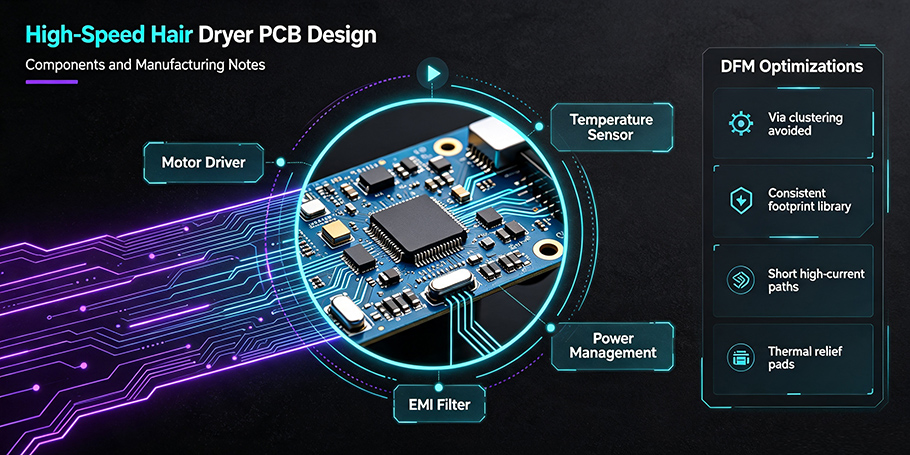
Key Challenges in High-Speed Hair Dryer PCB Design
Designing a PCB for a high-speed hair dryer presents unique challenges that require careful consideration during the design phase:
Motor Control: High-speed brushless DC (BLDC) motors require precise control circuits to maintain speed and torque while minimizing noise and vibration.
Thermal Management: Hair dryers generate significant heat, which can damage sensitive electronic components if not properly dissipated.
EMI Compliance: The high-frequency switching of motor drivers can emit electromagnetic radiation that must meet regulatory standards like FCC Part 15 and CE EN 55014.
Space Constraints: Modern hair dryers are compact, requiring high-density PCB layouts that are still easy to manufacture and assemble.
PCB Design for Manufacture Best Practices for High-Speed Hair Dryers
1. Optimize Motor Control Circuits for Manufacturability
The motor control circuit is the heart of any High-Speed Hair Dryer Solution. To optimize for PCB design for manufacture, choose components that are readily available, cost-effective, and easy to assemble. For example, use surface-mount device (SMD) components instead of through-hole components to reduce assembly time and improve reliability.
Implementing a modular design can also improve manufacturability. Separate the motor driver, power management, and control circuits into distinct sections of the PCB, making it easier to test and repair individual components. This modular approach also allows for easier scaling if you need to produce different models of hair dryers with varying power levels.
2. Design for Effective Thermal Management
Thermal management is critical for ensuring the long-term reliability of a high-speed hair dryer PCB. During PCB design for manufacture, incorporate features that help dissipate heat away from sensitive components:
Copper Pours: Use large copper areas on the PCB to act as heat sinks for components like motor drivers and power transistors.
Heat Vias: Place heat vias under high-power components to transfer heat from the top layer of the PCB to the bottom layer, improving heat dissipation.
Component Placement: Position high-power components away from sensitive components like microcontrollers and temperature sensors to reduce heat transfer.
When designing for thermal management, consider the manufacturing process as well. For example, using thicker copper (2 oz instead of 1 oz) can improve heat dissipation but may increase manufacturing costs. Work with your PCB manufacturer to find the right balance between performance and cost.
3. Ensure EMI Compliance Through DFM
EMI compliance is a key requirement for any electronic device, including high-speed hair dryers. During PCB design for manufacture, incorporate features that help reduce electromagnetic emissions:
Ground Planes: Use a solid ground plane to provide a low-impedance path for return currents, reducing EMI emissions.
Filter Circuits: Add EMI filter components like capacitors and inductors to the power input and motor output circuits to suppress high-frequency noise.
Trace Routing: Keep high-speed traces short and direct, and avoid routing them near sensitive components or connectors to reduce EMI coupling.
Working with a PCB manufacturer that has experience in EMI compliance can also help ensure your design meets regulatory standards. They can provide guidance on component selection and layout techniques that help reduce EMI emissions during the manufacturing process.
4. Optimize PCB Layout for Assembly and Testing
During PCB design for manufacture, consider the assembly and testing processes to reduce production costs and improve quality:
Component Spacing: Leave enough space between components to allow for automated assembly and manual soldering if needed.
Test Points: Add test points to the PCB to make it easier to test individual components and circuits during production.
Panelization: Design the PCB to be panelized with multiple units per panel, reducing manufacturing costs and improving assembly efficiency.
Why FYPCB is the Right Partner for High-Speed Hair Dryer PCB Design
At FYPCB, we specialize in PCB design for manufacture for High-Speed Hair Dryer Solutions. Our team of experienced PCB designers has deep knowledge of the unique challenges of hair dryer PCB design, including motor control, thermal management, and EMI compliance. We work closely with you to understand your requirements and design a PCB that meets your performance, cost, and manufacturability goals.
We use industry-leading design tools like Altium Designer and Cadence Allegro to create high-quality PCB layouts, and we follow a structured design process that includes DFM analysis, thermal simulation, and EMI testing. Our manufacturing partners are certified to ISO 9001 and IPC-A-610 standards, ensuring your PCBs are produced to the highest quality standards.
Contact us today to schedule a free consultation and learn how we can help you design and manufacture a high-quality PCB for your high-speed hair dryer solution.
