
 Electronics Design & Development
 PCB Design & Layout Services
 PCB Fabrication & Prototyping
 PCB Assembly & PCBA Services





Lithium Battery Protection Solution: PCB Design for Manufacture Best Practices
Lithium Battery Protection Solution: PCB Design for Manufacture Best Practices
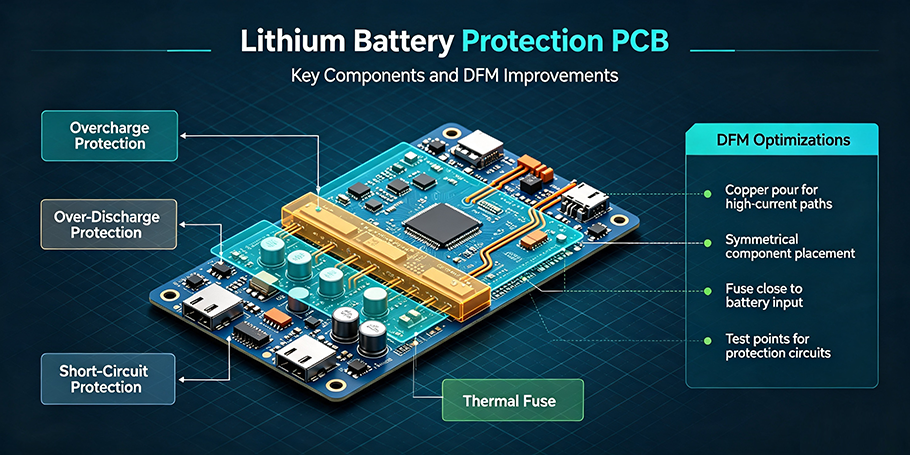
Lithium-ion batteries power everything from smartphones to electric vehicles, but their high energy density requires robust protection circuits to prevent overcharge, over-discharge, short-circuiting, and thermal runaway. For manufacturers, implementing PCB design for manufacture (DFM) best practices is critical to producing reliable, cost-effective Lithium Battery Protection Solutions that meet global safety standards like IEC 62133 and UL 1642.
Key Challenges in Lithium Battery Protection PCB Design
Designing a PCB for lithium battery protection presents unique challenges that require careful consideration during the design phase:
Safety Compliance: Battery protection circuits must meet strict safety standards to prevent fire or explosion risks, requiring precise component selection and layout.
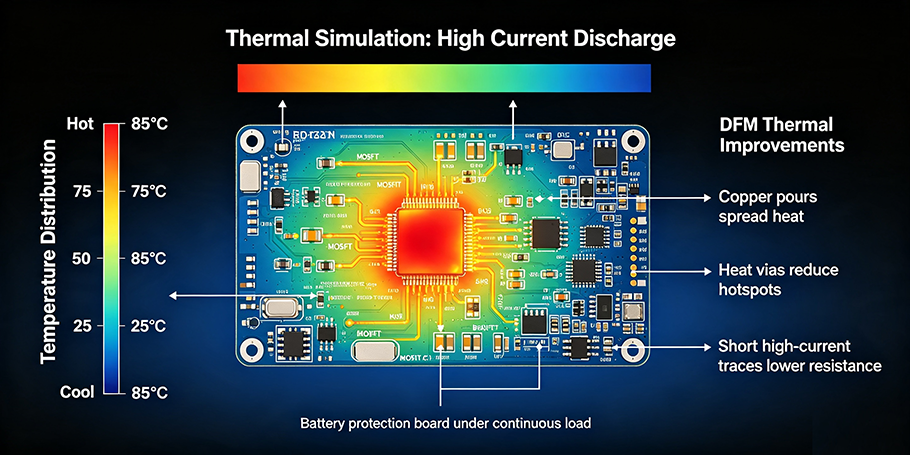
Thermal Management: High current discharge can generate significant heat, which can damage sensitive components or trigger thermal runaway if not properly dissipated.
Component Tolerances: Protection ICs and passive components must have tight tolerances to ensure accurate voltage and current detection, which can impact manufacturability.
Space Constraints: Battery protection PCBs are often small and must fit within limited spaces in battery packs, requiring high-density layouts that are still easy to assemble.
PCB Design for Manufacture Best Practices for Lithium Battery Protection Solutions
1. Optimize Component Selection for Manufacturability and Safety
The foundation of any reliable Lithium Battery Protection Solution is high-quality components that balance safety, performance, and manufacturability. When selecting components for PCB design for manufacture, choose protection ICs with built-in safety features like overcharge/over-discharge detection, short-circuit protection, and thermal shutdown.
Use surface-mount device (SMD) components instead of through-hole components to reduce assembly time and improve reliability. SMD components are also smaller, allowing for more compact PCB designs. When selecting passive components like resistors and capacitors, choose parts with tight tolerances (±1% or better) to ensure accurate voltage and current detection.
2. Design Layout for Effective Thermal Management
Thermal management is critical for ensuring the long-term reliability of lithium battery protection PCBs. During PCB design for manufacture, incorporate features that help dissipate heat away from sensitive components:
Copper Pours: Use large copper areas on the PCB to act as heat sinks for high-power components like MOSFETs and current sense resistors.
Heat Vias: Place heat vias under high-power components to transfer heat from the top layer of the PCB to the bottom layer, improving heat dissipation.
Component Placement: Position high-power components away from sensitive components like protection ICs and temperature sensors to reduce heat transfer.
When designing for thermal management, consider the manufacturing process as well. Using thicker copper (2 oz instead of 1 oz) can improve heat dissipation but may increase manufacturing costs. Work with your PCB manufacturer to find the right balance between performance and cost.
3. Ensure Compliance with Global Safety Standards
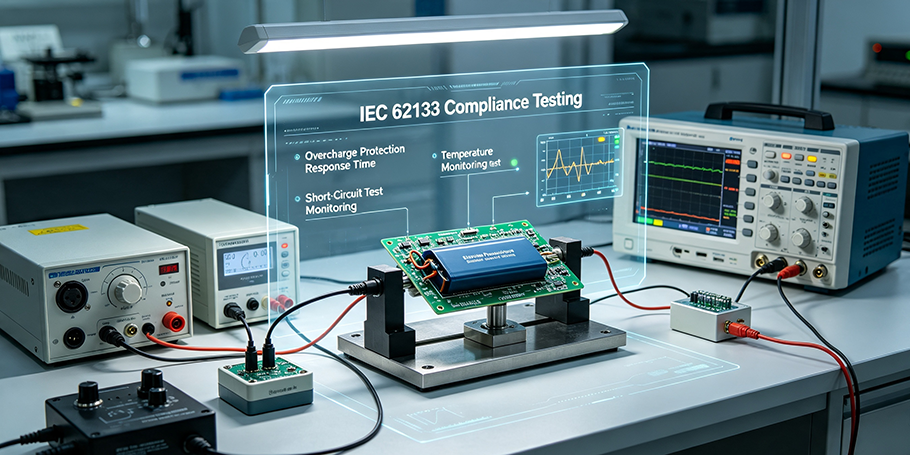
Compliance with global safety standards is non-negotiable for lithium battery protection solutions. During PCB design for manufacture, incorporate features that help your product meet standards like IEC 62133, UL 1642, and UN 38.3:
Fuse Placement: Place a thermal fuse or PTC (Positive Temperature Coefficient) resistor near the battery terminals to disconnect the circuit in case of overheating.
Isolation: Use isolation barriers between high-voltage and low-voltage circuits to prevent electrical shock risks.
Test Points: Add test points to the PCB to make it easier to test compliance with safety standards during production.
Working with a PCB manufacturer that has experience in battery protection design can also help ensure your product meets safety standards. They can provide guidance on component selection and layout techniques that help reduce safety risks during the manufacturing process.
4. Optimize PCB Layout for Assembly and Testing
During PCB design for manufacture, consider the assembly and testing processes to reduce production costs and improve quality:
Component Spacing: Leave enough space between components to allow for automated assembly and manual soldering if needed.
Panelization: Design the PCB to be panelized with multiple units per panel, reducing manufacturing costs and improving assembly efficiency.
Marking: Add clear marking to the PCB to indicate component polarity, pin functions, and test points, making assembly and testing easier.
Why FYPCB is the Right Partner for Lithium Battery Protection PCB Design
At FYPCB, we specialize in PCB design for manufacture for Lithium Battery Protection Solutions. Our team of experienced PCB designers has deep knowledge of the unique challenges of battery protection PCB design, including safety compliance, thermal management, and high-density layout. We work closely with you to understand your requirements and design a PCB that meets your performance, cost, and safety goals.
We use industry-leading design tools like Altium Designer and Cadence Allegro to create high-quality PCB layouts, and we follow a structured design process that includes DFM analysis, thermal simulation, and compliance testing. Our manufacturing partners are certified to ISO 9001 and IPC-A-610 standards, ensuring your PCBs are produced to the highest quality standards.
Contact us today to schedule a free consultation and learn how we can help you design and manufacture a high-quality, cost-effective PCB for your lithium battery protection solution.
