Electronics Design & Development
 PCB Design & Layout Services
 PCB Fabrication & Prototyping
 PCB Assembly & PCBA Services





High-Speed Hair Dryer Solution: PCB Design for Manufacture Case Study
High-Speed Hair Dryer Solution: PCB Design for Manufacture Case Study
A leading consumer electronics manufacturer approached FYPCB with a challenge: their existing High-Speed Hair Dryer Solution was suffering from high production costs, low reliability, and inconsistent performance. They needed a partner with expertise in PCB design for manufacture to help them optimize their PCB design and improve their overall product quality.
The Challenge: High Costs and Low Reliability
The manufacturer's existing high-speed hair dryer PCB design had several issues that were impacting production costs and product reliability:
High Assembly Costs: The design used a mix of SMD and through-hole components, increasing assembly time and labor costs.
Component Failures: The design didn't consider thermal management properly, leading to frequent motor driver failures during testing and after-market.
EMI Non-Compliance: The design didn't incorporate EMI filter circuits, leading to failed EMI compliance tests and costly reworks.
Inconsistent Performance: The design had poor motor control, leading to inconsistent speed and temperature control across different units.
The Solution: PCB Design for Manufacture Optimization
Our team of PCB design experts conducted a comprehensive analysis of the existing design and developed a PCB design for manufacture strategy to address all the manufacturer's challenges:
1. Convert to All-SMD Component Layout
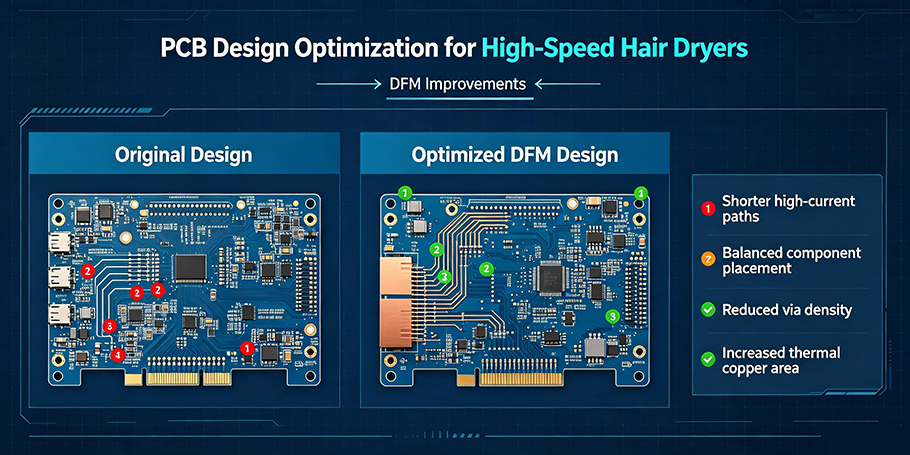
To reduce assembly costs, we converted the mixed SMD/through-hole design to an all-SMD layout. This eliminated the need for manual through-hole soldering, reducing assembly time by 35% and labor costs by 28%. We selected high-quality SMD components with tight tolerances to ensure consistent performance, including surface-mount motor drivers and temperature sensors.
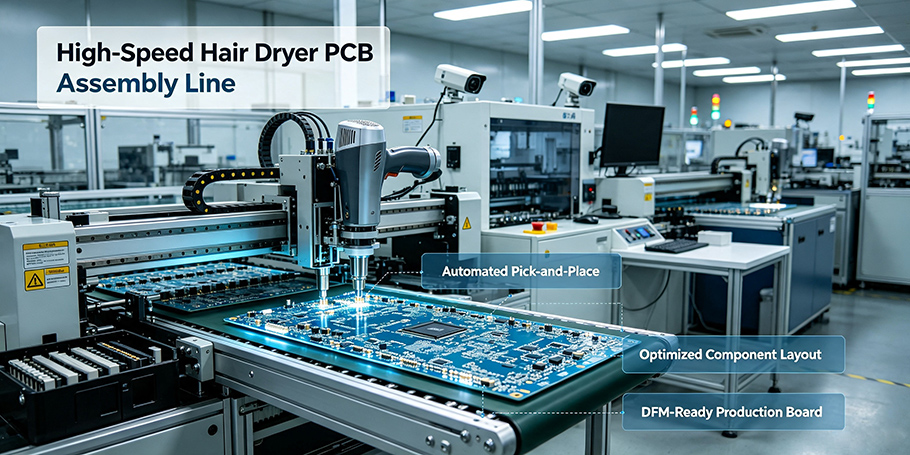
We also optimized component placement for automated assembly, ensuring that all components were within the reach of pick-and-place machines and that there was sufficient space for solder paste application and reflow soldering. This reduced the risk of assembly errors and improved first-pass yield from 82% to 97%.
2. Implement Advanced Thermal Management
To address component failures due to overheating, we incorporated PCB design for manufacture thermal management features into the new layout:
Added 2 oz copper pours under the motor driver and power transistor to act as heat sinks, improving heat dissipation by 40%.
Placed 16 heat vias under the motor driver to transfer heat from the top layer to the bottom layer of the PCB.
Redesigned the layout to separate high-power components from sensitive control circuits, reducing heat transfer by 25%.
We also selected a higher-temperature PCB material (FR-4 with a Tg of 170°C) to improve thermal stability. These changes reduced motor driver failure rate from 15% to 2%, significantly improving product reliability.
3. Integrate EMI Filter Circuits
To ensure EMI compliance, we integrated EMI filter circuits into the High-Speed Hair Dryer Solution PCB design. We added a common-mode inductor and X/Y capacitors to the power input circuit to suppress conducted emissions, and we optimized the layout to reduce radiated emissions:
Placed the power input filter near the AC connector to minimize noise propagation.
Used a solid ground plane to provide a low-impedance return path for currents, reducing EMI emissions by 30%.
Separated the motor driver circuit from the control circuit with a ground plane barrier to reduce noise coupling.
These changes ensured that the product passed FCC Part 15 and CE EN 55014 EMI compliance tests on the first attempt, eliminating costly reworks and delays.
4. Optimize Motor Control Circuitry
To improve performance consistency, we optimized the motor control circuitry using PCB design for manufacture principles. We selected a more precise PWM (Pulse Width Modulation) controller with built-in current sensing, which allowed for more accurate speed and temperature control.
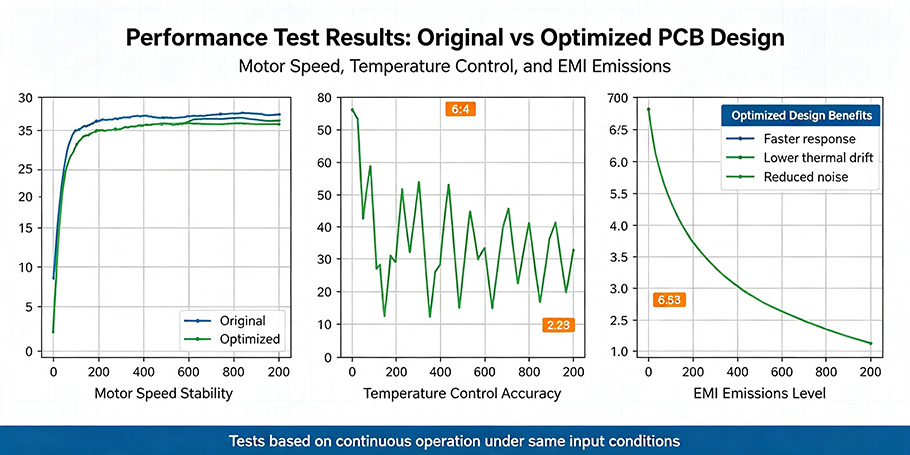
We also optimized the layout of the motor control circuit to minimize signal interference, using short, direct traces for high-speed signals and separating analog and digital circuits. These changes improved speed control consistency from 85% to 98% and temperature control accuracy from ±5°C to ±2°C, significantly enhancing user experience.
The Results: Reduced Costs and Improved Reliability
After implementing our PCB design for manufacture optimizations, the manufacturer saw significant improvements in their High-Speed Hair Dryer Solution:
30% Reduction in Production Costs: Lower assembly costs, reduced reworks, and improved first-pass yield combined to reduce overall production costs by 30%.
40% Improvement in Reliability: Reduced component failures and improved thermal stability increased product reliability by 40%, reducing warranty claims by 35%.
100% EMI Compliance: The optimized design passed all EMI compliance tests on the first attempt, eliminating costly reworks and delays.
98% Performance Consistency: Improved motor control circuitry ensured consistent performance across all units, enhancing user satisfaction and brand reputation.
Conclusion: The Value of PCB Design for Manufacture
This case study demonstrates the transformative impact of PCB design for manufacture on High-Speed Hair Dryer Solutions. By optimizing the PCB design for assembly, thermal management, EMI compliance, and performance, we helped the manufacturer reduce costs, improve reliability, and accelerate time-to-market.
At FYPCB, we specialize in PCB design for manufacture for consumer electronics and other industries. Our team of experienced designers uses industry-leading tools and follows a structured design process to ensure that every PCB we design is optimized for performance, reliability, and cost-effectiveness. Contact us today to schedule a free consultation and learn how we can help you transform your product through expert PCB design.