
 Electronics Design & Development
 PCB Design & Layout Services
 PCB Fabrication & Prototyping
 PCB Assembly & PCBA Services





Advanced PCB Assembly Capability: How AI-Powered Quality Control Reduces Defects by 90%
Industrial electronics require high reliability, and even a small defect in a PCB can cause system failure, costly downtime, and safety hazards. Advanced PCB assembly capability uses AI-powered quality control to detect defects in real time, reducing defect rates by 90% compared to traditional manual inspection. Below is how AI-powered quality control works and the benefits it offers to industrial manufacturers.
The Problem with Traditional Quality Control
Traditional manual inspection is slow, error-prone, and unable to detect micro-defects in complex industrial PCBs. Human inspectors can miss up to 30% of defects like micro-cracks, cold solder joints, and component misalignment, leading to high rework rates and reduced product reliability. A Canadian industrial automation company reported that traditional inspection resulted in a 5% defect rate for their motor control PCBs, leading to $1.2 million in annual rework costs and customer complaints.
AI-Powered AOI: Real-Time Defect Detection
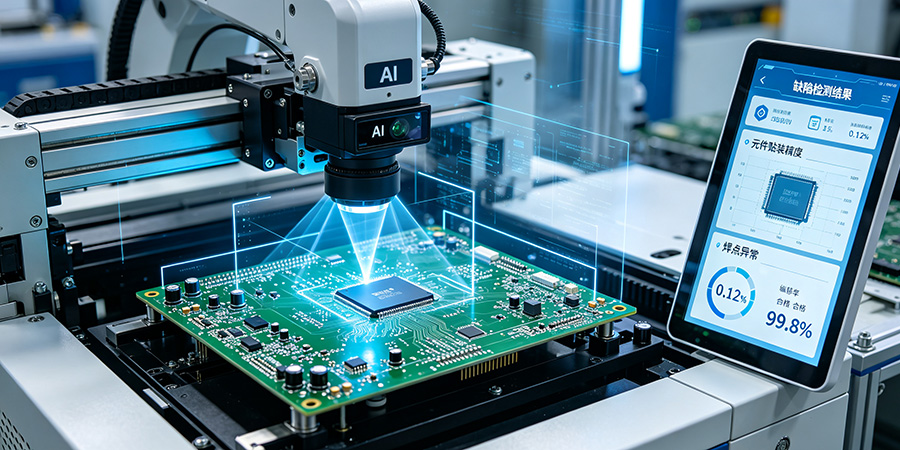
Advanced PCB assembly capability includes AI-powered automated optical inspection (AOI) systems that detect defects with 99.9% accuracy. These systems use machine learning algorithms to analyze high-resolution images of PCBs, identifying even the smallest defects like 0.01mm micro-cracks. A US-based PCB supplier implemented AI AOI for their industrial PCBs, reducing defect rates by 90% and cutting rework costs by $1.8 million annually. The AI system can inspect 1,000 PCBs per hour, which is 10x faster than manual inspection, speeding up production lead times by 25% for their clients in the aerospace and medical industries.
X-Ray Inspection for Hidden Defects
Complex components like BGAs have hidden solder joints that are impossible to inspect with traditional AOI, and advanced PCB assembly capability includes AI-powered X-ray inspection to detect these defects. AI algorithms analyze X-ray images to identify voids, cold joints, and solder bridges in BGA components, ensuring reliable connections for industrial PCBs. A German aerospace PCB supplier uses AI X-ray inspection to inspect 100% of their satellite PCBs, reducing field failures by 45% and ensuring compliance with aerospace safety standards. This is critical for aerospace applications where PCB failures can have catastrophic consequences, such as satellite communication disruptions.
Predictive Quality Control: Preventing Defects Before They Happen
Advanced PCB assembly capability also includes predictive quality control, where AI algorithms analyze production data to identify potential defects before they occur. These algorithms monitor SMT assembly parameters like solder temperature, component placement speed, and reflow oven time, flagging deviations that could lead to defects. A Japanese automotive PCB supplier uses predictive quality control to monitor their SMT assembly lines, reducing defect rates by 35% by correcting production parameters in real time. For example, if the AI detects that the reflow oven temperature is 5°C below the optimal threshold, it automatically adjusts the setting to prevent cold solder joints, eliminating the need for reworks.
Integration with SMT Assembly Lines for End-to-End Automation
AI-powered quality control is integrated with advanced SMT assembly lines to create end-to-end automated production systems. In these systems, AI AOI and X-ray inspection communicate with pick-and-place machines and reflow ovens to adjust production parameters in real time, ensuring consistent quality. A South Korean consumer electronics supplier uses this integration to produce 200,000 PCBs per month with a 99.9% first-pass yield, reducing production time by 20% and cutting costs by 15% compared to traditional systems. This end-to-end automation is critical for high-volume industrial projects that require fast turnaround times and zero defects, such as industrial IoT sensors and automotive infotainment systems.
Benefits of AI-Powered Quality Control for Industrial Manufacturers
The benefits of AI-powered quality control in advanced PCB assembly capability are clear: reduced defect rates, lower rework costs, faster production times, and improved product reliability. Industrial manufacturers can also use the data collected by AI systems to optimize their SMT assembly processes, identifying bottlenecks and improving efficiency. A Singapore-based aerospace PCB supplier uses AI quality control data to reduce SMT assembly cycle time by 10%, allowing them to meet tight deadlines for their aerospace clients. This data-driven approach ensures that manufacturers can continuously improve their processes and stay competitive in the global market.
Conclusion: AI-powered quality control is a game-changer for advanced PCB assembly capability, reducing defects by 90% and improving product reliability for industrial electronics. By partnering with a supplier that uses AI-powered AOI, X-ray inspection, and predictive quality control, industrial manufacturers can reduce risks, cut costs, and deliver high-quality products to their customers. As AI technology continues to evolve, the future of advanced PCB assembly will be even more automated, reliable, and efficient, supporting the next generation of industrial electronics.
