
 Electronics Design & Development
 PCB Design & Layout Services
 PCB Fabrication & Prototyping
 PCB Assembly & PCBA Services





SMT Assembly Capability: How Advanced Technology Outperforms Traditional Methods for High-Volume Production
High-volume PCB production requires efficient, reliable assembly processes, and the difference between traditional and advanced SMT assembly capability is night and day. Traditional manual assembly is slow, error-prone, and unsuitable for modern industrial electronics, while advanced SMT assembly capability uses automated systems to deliver superior efficiency, quality, and scalability. Below is a detailed comparison of the two methods and the benefits of advanced SMT assembly capability.
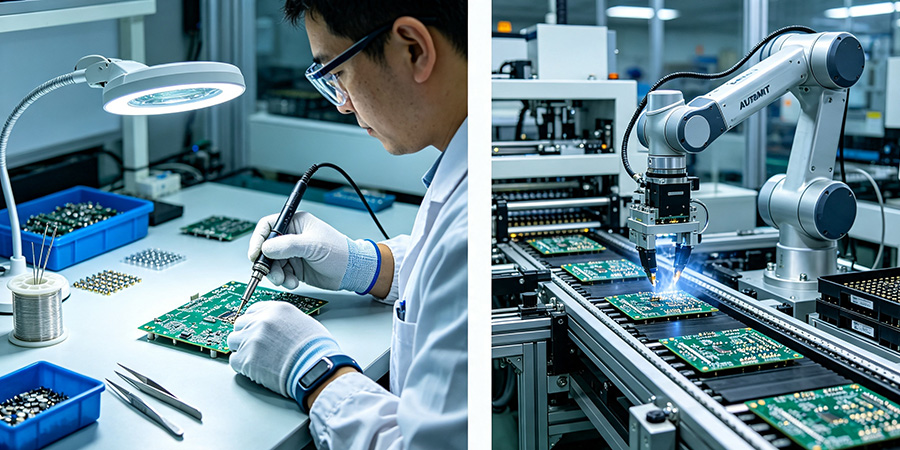
Traditional SMT Assembly: Limitations for High-Volume Production
Traditional SMT assembly relies on manual component placement and soldering, which is time-consuming and prone to human error. Technicians can place only 50–100 components per hour, compared to 500,000+ components per hour with advanced automated systems. This makes traditional assembly unsuitable for high-volume industrial projects, where even a small delay can lead to missed market deadlines. Traditional assembly also has a high defect rate—up to 5% for complex PCBs—due to manual soldering errors like cold joints and component misalignment. This results in costly reworks and reduced product reliability for industrial applications.
Advanced SMT Assembly Capability: Automated Systems for Efficiency
Advanced SMT assembly capability uses automated pick-and-place machines, reflow ovens, and AI-powered quality control to streamline production. These systems can place components with ±0.02mm accuracy, ensuring reliable connections for high-density industrial PCBs. A Chinese PCB supplier uses advanced SMT assembly lines to produce 200,000 consumer electronics PCBs per month, with a 99.9% first-pass yield. The automated lines reduce production time by 80% compared to traditional methods, allowing the supplier to meet tight deadlines for their clients in the automotive and medical industries.
AI-Powered Quality Control for Zero Defects
Advanced SMT assembly capability includes AI-powered quality control to detect defects in real time. AI-driven AOI systems can identify micro-cracks, solder bridges, and component misalignment with 99.9% accuracy, reducing false positives by 40% compared to manual inspection. A European PCB supplier uses AI AOI to inspect 15,000 industrial PCBs daily, ensuring no faulty boards reach customers. This not only improves quality but also speeds up production by eliminating reworks and manual inspection time.
Scalability for Fluctuating Demand
High-volume production often has fluctuating demand, and advanced SMT assembly capability includes scalable production lines that can adapt to changes in order volume. Top suppliers use modular SMT lines that can be expanded or reduced based on client needs, ensuring efficient production without overcapacity. A US-based PCB supplier scaled their SMT assembly lines from 10,000 to 100,000 PCBs per week to meet seasonal demand for industrial IoT devices, reducing production costs by 25% compared to maintaining fixed capacity.
Cost-Effectiveness in the Long Run
While advanced SMT assembly capability requires a higher upfront investment, it is more cost-effective in the long run. Automated systems reduce labor costs by 70% compared to traditional manual assembly, and the lower defect rate eliminates costly reworks. A Japanese automotive PCB supplier reported that implementing advanced SMT assembly reduced their annual production costs by $3.5 million, while improving product reliability for their electric vehicle clients. This cost savings is passed on to industrial clients, making advanced SMT assembly a more affordable option for high-volume projects.
Environmental Benefits of Advanced SMT Assembly
Advanced SMT assembly capability also has environmental benefits. Automated systems use lead-free solder and energy-efficient reflow ovens, reducing carbon emissions by 40% compared to traditional manual assembly. A German PCB supplier uses solar-powered SMT lines to produce industrial PCBs, reducing their carbon footprint by 50% and meeting the sustainability goals of their automotive clients. This makes advanced SMT assembly a more eco-friendly option for industrial projects that prioritize sustainability.
Conclusion: Advanced SMT assembly capability outperforms traditional methods in efficiency, quality, scalability, and cost-effectiveness for high-volume industrial projects. By partnering with a supplier that uses automated SMT systems, you can reduce production time, improve product reliability, and lower costs. As industrial electronics become more complex, advanced SMT assembly capability will be essential for meeting the demands of modern manufacturing.
