
 Electronics Design & Development
 PCB Design & Layout Services
 PCB Fabrication & Prototyping
 PCB Assembly & PCBA Services





Embedded Linux Board Development: What to Define Before Outsourcing Hardware
Embedded Linux Board Development: What to Define Before Outsourcing Hardware
“We need a custom Linux board” sounds like a hardware request, but it usually contains three different decisions: which processor platform to use, how the interfaces fit the product, and who will own the software work needed to make the board useful. If those decisions are left until PCB routing, the project can spend weeks chasing changes that should have been settled at the architecture review.
Start with the product's interfaces, not the processor headline
A processor with an impressive core count is not necessarily the best fit. List the actual interfaces: display resolution and type, camera lanes, Ethernet ports, USB speed, CAN or RS-485, storage, audio, wireless connectivity and any isolation requirement. Then add which interfaces must operate simultaneously. A reference design may expose a connector that shares internal pins with another function, or it may rely on a peripheral that is unavailable in the intended package.
For an industrial gateway, for example, two Ethernet ports and isolated serial channels may matter more than graphics performance. For a camera product, memory bandwidth, image input and sustained thermal behavior become central. The architecture should reflect the workload, not a generic development-kit feature list.
Choose between a system-on-module and a full custom board
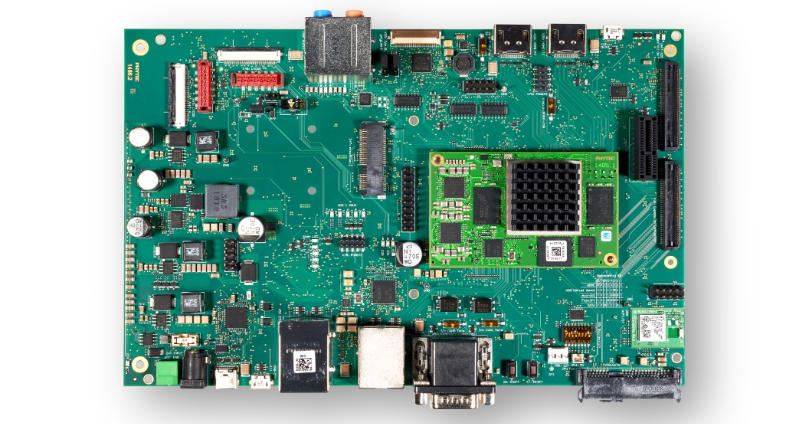
A system-on-module can shorten early development by keeping DDR, PMIC and processor escape routing on a proven module. The carrier still needs careful power sequencing, connector protection, signal integrity and mechanical design. A fully custom board may make sense when cost, size, supply chain or long-term volume justify the additional design and validation work.
Ask for both paths to be considered when the commercial case is not obvious. Compare unit cost at realistic quantities, module availability, thermal constraints, software support and the cost of redesign if a component becomes obsolete.
Software ownership must be written into the hardware scope
A board that powers up is not the same as a board that boots Linux reliably. Clarify responsibility for the bootloader, device tree, kernel drivers, BSP version, secure boot, recovery mode and production programming. If the customer owns the software, define what the hardware team will provide for bring-up: UART console, boot-mode access, JTAG where appropriate, test points and a documented power-up sequence.
| Decision | Question to settle |
|---|---|
| Compute platform | SoM or custom SoC? Which lifecycle and BSP? |
| Interfaces | What operates concurrently, at what speed? |
| Boot and storage | eMMC, SD, QSPI, recovery and programming? |
| Power | Input range, sequencing, standby and peak load? |
| Validation | What is the acceptance test for the first prototype? |
Thermal and mechanical decisions are not late-stage details
A processor can boot successfully on an open bench and throttle inside a sealed enclosure. Share enclosure drawings, ambient limits, airflow assumptions, mounting points and the intended heat path before layout. Connector height and cable bend radius can be just as decisive as processor temperature when the PCB has to fit a finished product.
What to send in the first RFQ
A useful request includes a block diagram, interface matrix, mechanical outline, target production quantity, operating environment, expected software support and acceptance criteria. If the product has an existing development board, include the known working configuration and the changes required for the commercial design.
FYPCB's electronics design and development services can be discussed from this architecture stage, with PCB layout, fabrication and prototype assembly coordinated around the same design intent. That is a better starting point than quoting a board from a processor name alone.
Discuss your PCB or electronics project with FYPCB
Share your requirements, drawings or BOM for an engineering and manufacturing review.
